Logo
Corporate Training

Train the Trainer vs Corporate Training Licence: How Singapore Companies Build In-House Training

Published on November 20, 2026By Team Dr. Jerome Joseph
Train the Trainer vs Corporate Training Licence: How Singapore Companies Build In-House Training

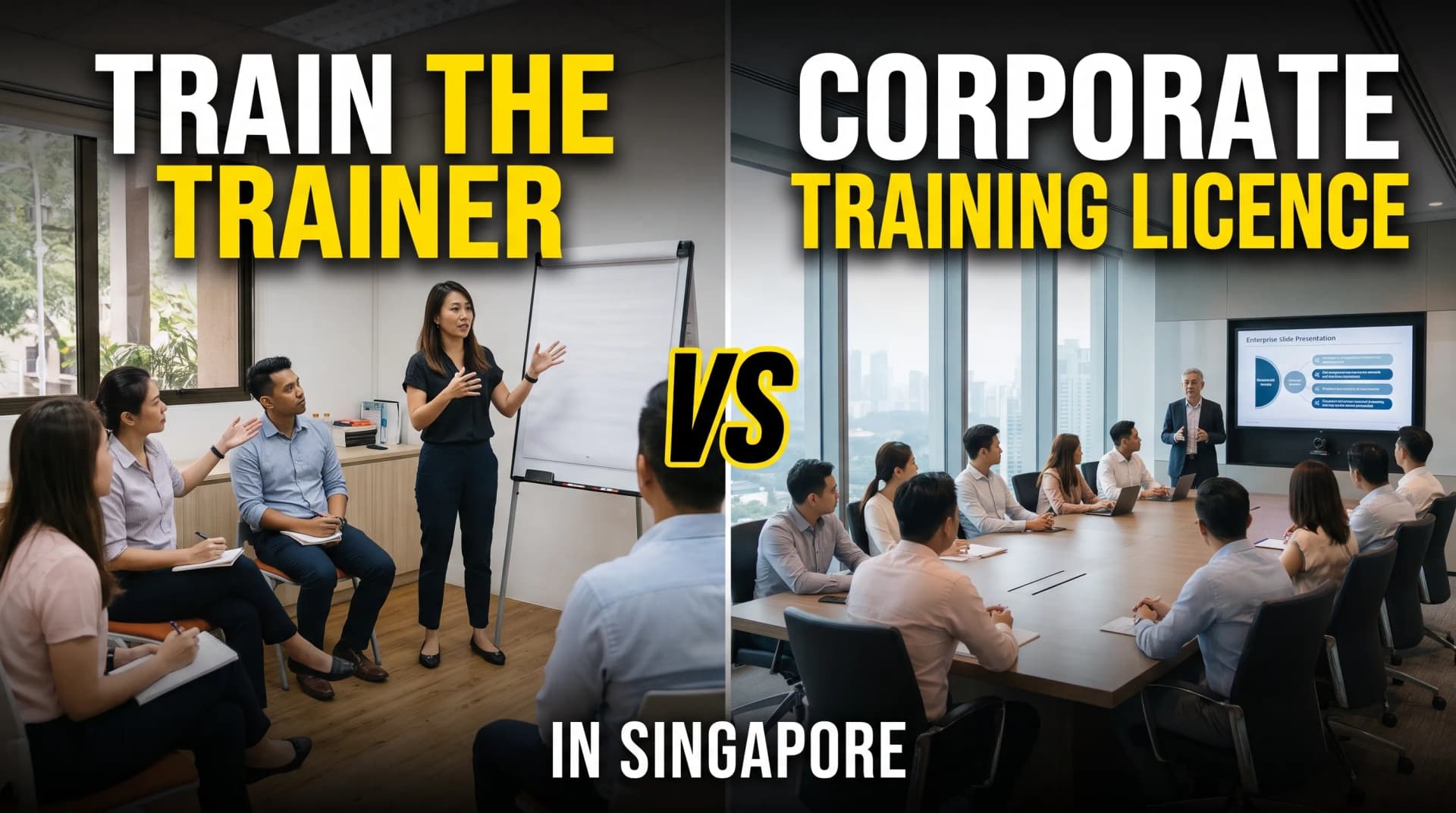
Train the trainer vs corporate training licence is a choice that comes up when a company wants to run training itself. Say the first programme goes well. Then the next question arrives. How do we run this ourselves, across more teams, without calling a provider every time?

Two routes answer that question. One builds your own trainers. The other gives your people a programme to run. They solve different problems. If you mix them up, you can end up with trained trainers and nothing to teach, or a good programme and nobody ready to deliver it.

We wrote this guide for HR, L&D and business leaders who want to bring training in-house. You will find plain definitions, a side-by-side table, five questions to help you decide, and a checklist to take into any provider conversation. Where it helps, we also show how corporate training licensing and certification works at Global Brand Academy.

What is train the trainer?

Train the trainer is training for the people who will teach. It builds their skill in planning a session, delivering it, handling a room and checking that learning landed. It answers one question: who will teach? On its own, it usually does not hand you a finished programme to teach.

The people who attend are often close to the work, such as HR and L&D staff, subject experts and team leaders. They know your business. What they may still need is a method for turning what they know into a session that other people can learn from.

Skill and content are two separate decisions. Train the trainer is the skill decision. Treat it that way.

Train the trainer works best when you already have material you trust. A strong trainer with weak material still delivers weak training. A weak trainer with strong material wastes it. That is why the two choices need to be made together, even when you buy them separately.

What is a corporate training licence?

A corporate training licence lets your organisation run a provider's programme with your own people. You receive the programme and its materials, adapted to your context, so that internal facilitators can deliver it. It answers a different question: what will they teach?

On our licensing page, the licence section lists four things:

  • A customised learning architecture aligned to your transformation goals

  • Signature modules adapted to your industry, culture and context

  • Facilitator guides and delivery decks, described as internal-ready

  • Participant workbooks and toolkits

The page lists five tracks. Each track comes as a Certification and as a Business Licence:

  • Brand Mastery

  • Branded Culture

  • Branded Customer Experience

  • Sales Mastery

  • AI Mastery

If you want to see how a licence works inside a real organisation, our corporate training case studies show several, and we cover them below.

Want your own people to run the training? Explore our corporate training licensing and certification.

What is the difference between train the trainer and a corporate training licence?

1795167573315-difference between train the trainer and a corporate training licence

The difference is what each one gives you. Train the trainer gives you teachers. A corporate training licence gives you the programme those teachers run. One builds skill in people. The other builds a ready system your people can deliver. A working in-house plan needs both parts in place.

Here is the comparison side by side.

Area

Train the trainer

Corporate training licence

Core question

Who will teach?

What will they teach?

What you build

Teaching skill in your people

A programme your people can run

What you receive

Skills in planning, delivery and facilitation

Learning architecture, signature modules, facilitator guides, delivery decks, participant workbooks and toolkits

Where the content comes from

Your own material, or material from elsewhere

The provider's framework, adapted to your industry and culture

Strongest when

You already have content you trust and need more people to deliver it

You want a proven programme and plan to run it yourself, many times

Risk if used alone

Trained trainers with nothing agreed to teach

A programme with nobody ready to deliver it well

Who delivers afterwards

Your trainers

Your trainers, using the licensed programme

Train the trainer vs corporate training licence: which one does your company need?

Choose train the trainer if you have content and need teachers. Choose a licence if you need a programme and have people willing to teach it. Choose both if you are missing both, or if you plan to roll out across many teams, offices or countries.

Use these signs to check where you stand.

Train the trainer alone is likely enough when:

  • You already have material your people trust

  • Subject experts teach today, but the quality varies from person to person

  • You need more confident facilitators, not a new programme

  • The topic is specific to your own products, tools or processes

A corporate training licence is likely the better fit when:

  • You want a proven programme without building one from nothing

  • You need the same programme to run in several teams or places

  • You want your own people to own delivery over the long term

  • The topic matches one of the five tracks: brand, culture, customer experience, sales or AI

You probably need both when:

  • You plan a rollout across many staff, partners or countries

  • You have no programme and no ready trainers

  • You want the programme to keep running after the provider steps back

What happens when companies use both?

When a company uses both, the licence gives the programme and the certification gives the people who can run it. Two clients on our case studies page show this pairing. The outcomes below are as reported on that page. They are not guarantees for any other organisation.

  • Sentosa Development Corporation: We designed a custom Experience and Service Culture licence and delivered Train-the-Trainer certification. It was rolled out across staff and island partners. The reported outcomes are a consistent service culture across the island and strong internal ownership of capability.

  • Master Builders Solutions (BASF): We delivered Branded Culture and Internal Branding Certification and leadership brand alignment across 25 countries, plus Train-the-Trainer certification. The reported outcomes are global internal brand alignment, leaders acting as brand champions and embedded culture capability.

Two more clients show the licence side on its own:

  • Lazada Group: We designed and built the Lazada Group Business University. It licensed our Brand Mastery and Customer Experience Mastery programmes, which created an internal learning ecosystem built on our intellectual property. The reported outcome is a scalable, licensed learning platform embedded across the organisation.

  • Senaat, Abu Dhabi Government: We designed a custom internal branding and culture licence, ran pilots and built programmes for organisation-wide rollout. The reported outcome is long-term internal ownership of capability development.

A licence gives you the programme. Train the trainer gives you the people who can run it.

Notice the common thread. Each reported outcome is about capability that stays inside the client's organisation. That is the real goal of going in-house. If you are still comparing options before you decide, read how to choose the right corporate training programme in Singapore first.

Not sure which route fits your team? Ask for a Certification and Licence overview.

How do you decide between them in five questions?

Answer five questions in order. They show whether you have a skill gap, a content gap or both. Write the answers down and share them with your provider. A clear brief gets you a clearer proposal, and a fairer comparison between providers.

  1. What are we trying to scale? A skill (more people who can teach), a programme (more places running the same thing), or both.

  2. Do we already have content we trust? If yes, train the trainer may be enough. If not, a licence closes that gap.

  3. Who will teach, and how much time do they really have? Teaching on top of a full job is hard. Name the people and check their time.

  4. How many teams, offices or countries will use this? The wider the rollout, the more a shared programme matters.

  5. Who must own this in two years? Name a person or a team. If nobody owns it, it will fade.

For more on why training fades once the session ends, read why employee training does not stick.

What should you ask a provider before you sign a licence?

Ask what the licence covers, what you can change, who owns what you adapt, how your trainers are prepared, and what support you get after rollout. Ask for the answers in writing. Written answers are easier to compare across providers, and easier to hold a provider to later.

Take this list into every provider conversation:

  • What exactly does the licence cover, and for which programmes?

  • Which parts can we adapt to our own industry and culture?

  • Who owns the material we adapt?

  • How are our trainers prepared and certified?

  • What happens when a trained trainer leaves our company?

  • How is the programme kept current over time?

  • What support do we get after rollout, and for how long?

  • How will we check that delivery stays consistent across teams?

What mistakes slow down in-house training?

Three mistakes slow in-house training down: buying skill without content, buying content without owners, and rolling out everywhere at once. Each one is easy to avoid if you name the owner early and test the programme with one team first. The table shows what to do and what to skip.

Do

Don't

Name one owner for the programme before you sign

Leave ownership to "whoever has time"

Pilot with one team first

Roll out to every team in the first month

Choose trainers who respect the material and know the business

Pick trainers only because they are senior

Agree how you will measure the result before you start

Judge success by attendance alone

Plan for what happens when a trainer leaves

Rely on one person to carry the programme

To agree how you will measure the result, our guide to ways to measure training ROI gives you a place to start. If your brief is still wide open, our guide to custom corporate training in Singapore shows how to write one.

How does Global Brand Academy approach licensing and certification?

Global Brand Academy offers licensing and certification across five tracks, using a five-stage pathway: Discover, Define, Develop, Deliver and Drive. Each track comes as a Certification and as a Business Licence. The aim is that your own people end up running the programme.

The five stages, as described on our licensing page:

  • Discover: Diagnose the current state, gaps and opportunities.

  • Define: Clarify direction, standards, behaviours and success measures.

  • Develop: Build frameworks, tools, learning assets and playbooks.

  • Deliver: Train leaders and teams, embed application and drive adoption.

  • Drive: Certify internal champions, licence the system and scale the rollout.

The page also names the problems these tracks are built for: unclear brand, a culture that is stated but not lived, uneven service, varying sales performance and fragmented AI adoption. To see how we work more broadly, read our approach. For the wider range of formats, see our corporate training in Singapore page.

Our licensing page does not list fees or terms. The best way to see both options for your track is to ask for a licence overview and talk it through with us.

Where should a company start?

Start with the five questions above, then pick one track and one team to pilot. Take the answers to a provider and ask for the written reply to each question in the checklist. Compare what you hear, not what you read.

A sensible first week looks like this:

  1. Write down what you want to scale, and who will own it.

  2. Check whether you already have content you trust.

  3. Choose one team for the first rollout.

  4. Use the question list to talk to two providers.

  5. Talk to our team if you would like us to take you through both options for your track.

Frequently asked questions

What is the difference between train the trainer and a corporate training licence?

Train the trainer builds the skill of the people who will teach. A corporate training licence gives your organisation a programme, with materials, that those people can deliver. One answers who will teach. The other answers what they will teach. A working in-house plan needs both answered.

Do we need a licence if we already have trainers?

Not always. If your trainers already have content you trust, they may only need stronger delivery skills. A licence helps when you want a proven programme, shared across teams or places, that your own people run for the long term.

Can we do train the trainer without a licence?

Yes. Train the trainer works well on its own when you already have your own material and need more people who can deliver it well. The risk is having trained trainers with no agreed programme, so settle the content first.

Which tracks does Global Brand Academy offer for licensing?

Our licensing page lists five tracks: Brand Mastery, Branded Culture, Branded Customer Experience, Sales Mastery and AI Mastery. Each track comes as a Certification and as a Business Licence. Ask for a licence overview and we will walk you through the track that fits your goals.

How much does a corporate training licence cost?

We do not list licence fees on our website. Tell us the track, the number of people who will teach and the teams you plan to reach, and we will talk it through. Use the checklist in this guide to compare what each provider includes.

Can a licence and certification work across several countries?

It has been done. One client case on our case studies page, Master Builders Solutions (BASF), covers Branded Culture and Internal Branding Certification across 25 countries, with Train-the-Trainer certification. The reported outcomes are global internal brand alignment and embedded culture capability.

Dr. Jerome Joseph - Recognized #2 Global Brand Guru

Dr. Jerome Joseph

Singapore-Based Global Keynote Speaker | Corporate Trainer |
Brand & AI Expert

LinkedInX (Twitter)YouTubeSpotifyFacebookTikTok

Dr. Jerome Joseph is a Singapore-based global keynote speaker, corporate trainer, brand strategist, AI and business transformation expert, and best-selling author.

With more than 30 years of experience, he has worked with over 1,000 brands across 41 countries, helping leaders, organisations and professionals strengthen their brands, embrace AI and improve business performance.

Ranked No. 2 in the world as a Global Brand Thought Leader in 2020 and 2022, Dr. Jerome is a former CEO and Board Member of a publicly listed brand agency, the author of 14 books, a Certified Speaking Professional (CSP), Global Speaking Fellow (GSF), and the youngest inductee into the Asia Speaker Hall of Fame.

He delivers international keynotes, corporate training and advisory programmes in AI, sales, branding, personal branding, leadership and customer experience.

Explore Dr. Jerome Joseph's keynotes, training and advisory programmes at website.

GET IN TOUCH WITH GLOBAL BRAND ACADEMY

Connect with Global Brand Academy for training, transformation, or strategic support, and build capabilities across brand, leadership, culture, sales, customer experience, and AI while bridging learning with real-world performance.

HOW CAN WE HELP YOU?

Let's Collaborate to Inspire, Transform, and Elevate Your Event, Organisation or Team.

Singapore
+65

Related Posts