Logo
Brand Transformation

The Real Reason Employee Training Doesn't Stick (It's Not the Training)

Published on August 10, 2026By Team Dr. Jerome Joseph
The Real Reason Employee Training Doesn't Stick (It's Not the Training)

It Held for Five Weeks

When training does not produce lasting change, the usual conclusion is that the training was not good enough. The provider gets reviewed. The content gets blamed. The next budget goes to someone else, who delivers a different programme that fades in exactly the same way.

The evidence points somewhere less comfortable. In most cases the programme was fine. It worked for about five weeks, and then something outside the programme quietly undid it. Ask any experienced L&D lead about the training they are proudest of and they will tell you about the delivery. The energy in the room, the quality of the discussion, the feedback scores.

Ask them what the organisation was doing differently six months later and the answer gets vaguer. This is not a failure of honesty. It is that most organisations genuinely do not know, because nobody was measuring anything after week two. The programme was treated as an event with a start date and an end date, and once the end date passed, attention moved to the next thing.

Meanwhile, something predictable was happening inside the business. The new approach was competing with the old one, and the old one had every structural advantage. It was already embedded in the process. It was what managers expected. It was what the systems supported. It required no additional effort. Within a quarter, in the absence of anything actively holding the new approach in place, the old one wins. Not through resistance. Through gravity. We have watched this across organisations of every size, and the interesting part is how consistent the timeline is.

The Decay Timeline

Here is roughly how it unfolds when nothing is built in to prevent it.

Weeks one and two. Enthusiasm is high. Participants try the new approach, often quite deliberately. Results are mixed, because they are unpractised, but effort is genuine. This period is what feedback surveys capture, which is why feedback surveys consistently overstate programme impact.

Weeks three and four. The first real pressure arrives. A deadline, a difficult client, a busy period. Under pressure, people revert to what they can do without thinking, which is the old approach. This is not a lapse in commitment. It is how skill acquisition works. New behaviour is effortful until it is not, and effort is the first thing sacrificed under load.

Weeks five and six. The critical window. Whether the new approach comes back after that first reversion depends almost entirely on whether anyone notices and says something. If a manager asks about it, it returns. If nobody does, the reversion becomes the new normal and the participant quietly concludes the programme was not really expected to change anything.

Weeks seven to twelve. Consolidation of whichever version won. By the end of the quarter the outcome is largely fixed, and further intervention costs far more than it would have in week five.

The important implication is that the decisive moment is not during delivery. It is around week five, and almost nobody plans for it.

Most programmes are designed for the two days. The quarter afterwards is where the outcome is decided.

What Has to Be Designed In Before Delivery

Everything that prevents decay has to exist before the programme runs. Added afterwards, these interventions arrive too late and land as remediation, which people resist.

Manager involvement, before the participants

The single highest return intervention available, and the one most often skipped for scheduling reasons.

If a participant's direct manager does not know what the programme covered, they cannot notice the reversion in week four, and they cannot ask the question in week five. They will not be being negligent. They simply will not have the information.

The version that works is short. An hour with the managers of participants, before delivery, covering three things. What their people are learning. What it should look like when applied. What to ask about in one to ones over the following six weeks.

That hour changes outcomes more reliably than doubling the length of the programme, because it works through the channel employees actually pay attention to. This is the same principle that underlies our wider corporate training work in Singapore, where manager preparation is treated as part of the programme rather than as an optional extra.

A second appointment

A programme with one date is an event. A programme with two dates is a commitment. The mechanism is simple and slightly uncomfortable, which is why it works. If participants know they will return in six weeks and be asked what they applied, they apply something. The second session does not need to be long. Ninety minutes, structured around what people actually tried, what happened, and what got in the way.

The content of that session matters less than its existence. It creates a deadline, and deadlines produce behaviour.

One thing, not nine

Most programmes teach too much. A two day session covering nine frameworks produces participants who remember none of them clearly enough to apply under pressure. The alternative is to identify the single behaviour that would make the most difference and build the programme around it, using the remaining content as support rather than as parallel material. Participants leave with one thing they can do on Monday. One thing applied beats nine things understood.

This is difficult to sell internally, because a programme covering nine topics looks like better value than one covering one. It is not, and the measurement afterwards will show it.

Removing the obstacle before it is hit

Before delivery, ask participants a single question. If you tried to do this tomorrow, what would stop you? The answers are usually specific and often solvable. A system that does not allow it. An approval step that makes it slow. A report that does not capture the new information. A manager in another function who expects the old way.

Fixing two or three of those before the programme runs removes the reasons people would otherwise revert. Discovering them afterwards means the programme has already failed for those participants.

The Measurement That Actually Tells You Something

Satisfaction scores measure whether a session was pleasant. Completion rates measure attendance. Neither tells you whether anything changed. The practical alternative is to name, before the programme, one observable thing that should be different afterwards. Not a feeling. Something a third party could verify.

Fewer escalations of a particular type. Faster turnaround on a specific process. Higher first contact resolution. More consistent handling of a defined situation. Then check it at week six and at week twelve. Week six tells you whether reinforcement is working while there is still time to correct. Week twelve tells you whether it held.

Two data points, chosen in advance, and you know more than a full page of satisfaction metrics will ever tell you. We apply the same logic across corporate training programmes in Singapore, setting the success criteria before design begins rather than after delivery, because a measure chosen afterwards will always be chosen to flatter the result.

When the Problem Is Not Training at All
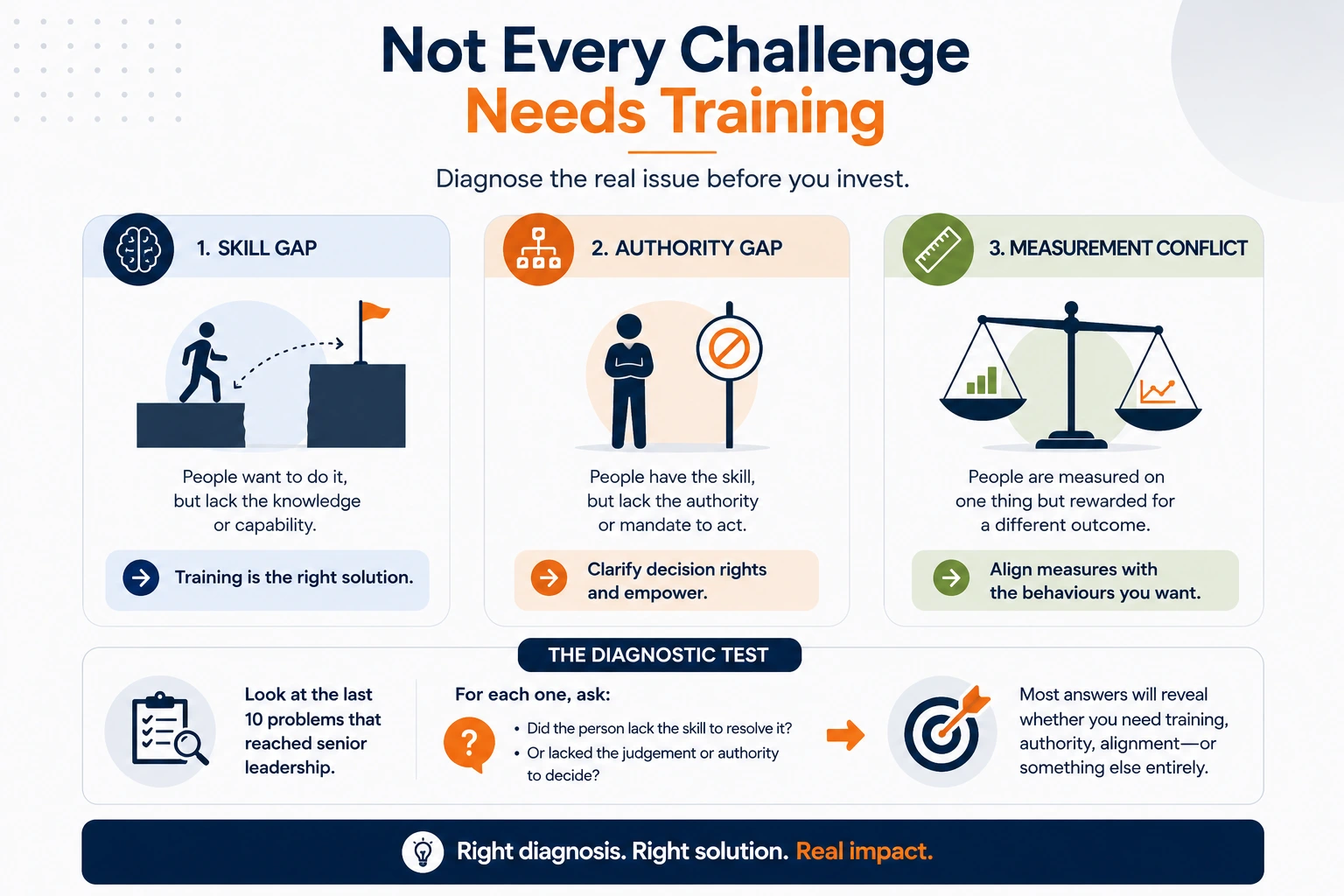
Image Aug 10, 2026, 07_48_01 AM

There is a point worth making plainly, because it saves organisations a great deal of money. Sometimes a programme fades not because reinforcement was missing, but because training was never the right intervention. If participants return and cannot apply what they learned because they lack the authority to make the relevant decision, no amount of reinforcement helps. That is a decision rights problem. If they can apply it but are measured on something that contradicts it, they will follow the measurement, and reinforcement simply makes the contradiction more visible and more demoralising.

Before commissioning any employee development programme, it is worth establishing which of three things you are dealing with. A skill gap, which training addresses. An authority gap, which requires a structural decision. Or a measurement conflict, which requires changing what gets rewarded. We set out that distinction more fully in our comparison of leadership training and broader corporate training, and the diagnostic takes about an hour using the last ten decisions that reached senior leadership.

The Singapore Consideration

Two local factors affect how these programmes get designed.

Funding shapes format. Government supported training funding in Singapore carries specific eligibility criteria that tend to favour accredited programmes with defined competency frameworks. This can significantly change the cost comparison between a bespoke internal design and an accredited programme, and it is worth checking eligibility before the design is finalised rather than after. Our overview of WSQ training programmes and why they matter for Singapore workplaces covers how this works in practice.

Tight labour markets change the retention calculation. In a market where replacing an experienced employee is slow and expensive, development programmes carry a retention value beyond the capability they build. People generally stay longer where they are visibly being invested in. That effect is real, though it depends entirely on the programme being perceived as genuine rather than as a formality, which brings the argument back to whether anything actually changed afterwards.

A Short Checklist
Five Questions That Protect Your Training Investment

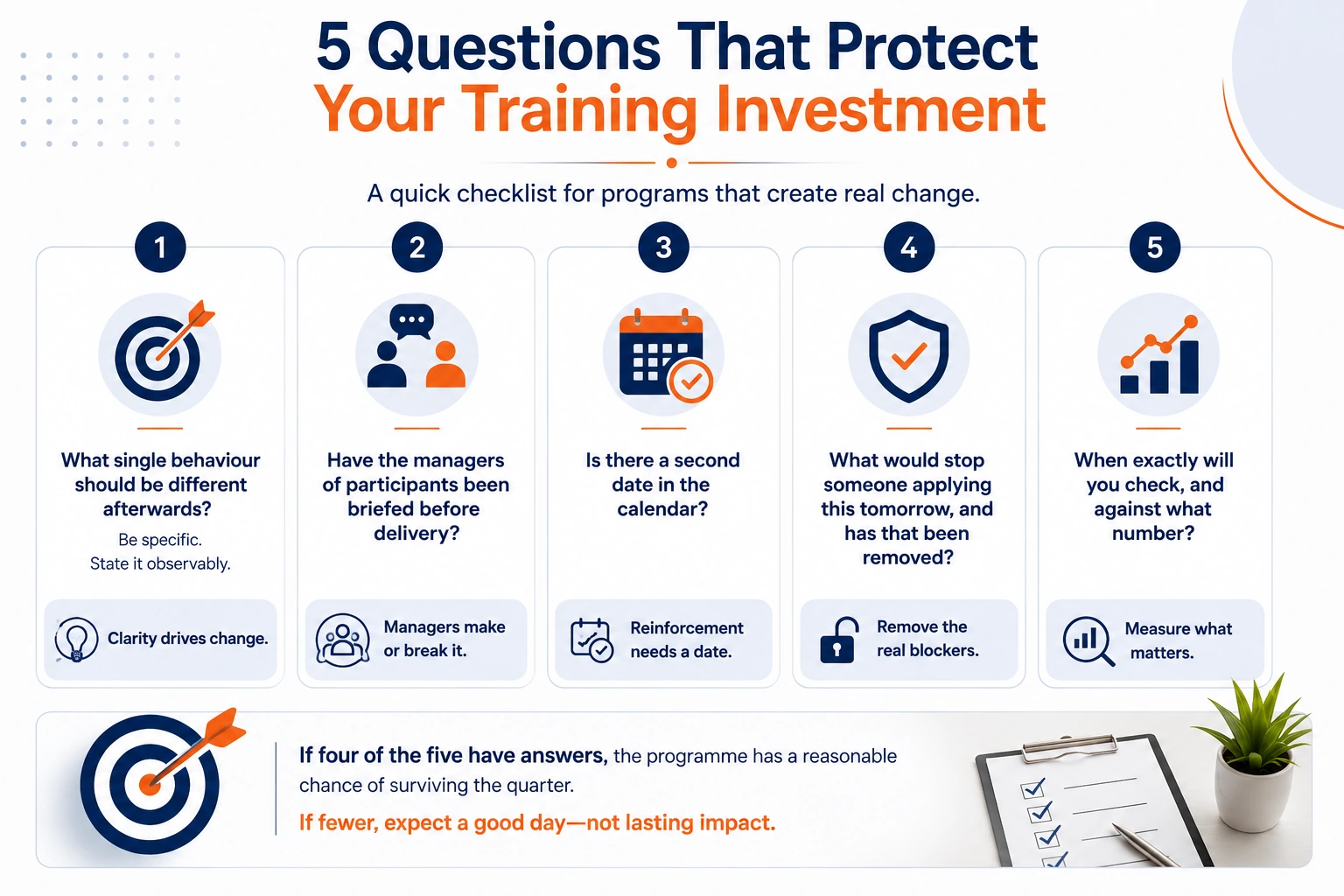
If you are designing a programme in the next quarter, these five questions cover most of the risk.

What single behaviour should be different afterwards, stated observably.

Have the managers of participants been briefed before delivery.

Is there a second date in the calendar.

What would stop someone applying this tomorrow, and has that been removed.

When exactly will you check, and against what number.

If four of the five have answers, the programme has a reasonable chance of surviving the quarter. If fewer, the delivery will probably go well and the effect will probably not last, which is the outcome most organisations get and few plan for.

Organisations that want this built in from the start rather than retrofitted will find that our corporate training in Singapore engagements are structured around the quarter that follows delivery, not around the days of delivery itself.

About Global Brand Academy

Global Brand Academy is a global strategic training and transformation partner, working with organisations, leaders, executives, sales professionals and entrepreneurs to build capability where it matters most across brand, leadership, culture, sales, customer experience and AI. Built on over 30 years of real world experience across 40+ countries, GBA has served more than 1,000 organisations and impacted over 1.2 million leaders, professionals and entrepreneurs. Our work is anchored around seven transformation domains and delivered through an integrated ecosystem of keynotes, masterclasses, coaching and certification, so learning moves from insight to capability and from intent to impact.

Global Brand Academy is founded and led by Dr Jerome Joseph, ranked No. 2 Global Brand Thought Leader in the World in 2020 and 2022, an award winning global speaker and best selling author of 12 books, whose doctoral work examined the impact of brand and culture on organisational performance. For organisations whose training consistently delivers well and fades quickly, that research background is directly relevant, because what holds a new behaviour in place is usually culture and manager behaviour rather than the quality of the session itself.

Frequently Asked Questions

Why does employee training fail to stick?

Usually because nothing reinforces it after delivery. New behaviour is effortful until it becomes habitual, and under work pressure people revert to what they can do without thinking. If nobody notices that reversion and asks about it, typically around week five, the old approach becomes the norm again. The failure is generally in the design of what follows the programme rather than in the programme itself.

How long should an employee development programme run?

Less important than whether there is a second appointment. A single day with a follow up session six weeks later consistently outperforms two consecutive days with nothing afterwards, because the second date creates an expectation that something will have been applied. Duration matters less than spacing.

What is the difference between employee training and employee development?

Training generally refers to building capability in a defined current activity, with a relatively short timeframe and observable output. Development refers to broader growth in capability and judgement over a longer horizon, often preparing someone for future responsibility rather than improving current performance. Most organisational programmes contain elements of both, and confusion between them is a common cause of mismatched expectations about how quickly results should appear.

How do you measure whether training worked?

Choose one observable indicator before the programme begins, something a third party could verify rather than a feeling. Then check it at week six and week twelve. Week six shows whether reinforcement is working while there is still time to intervene. Week twelve shows whether it held. Satisfaction scores measure whether a session was pleasant and predict very little about behaviour change.

Should managers attend the same training as their teams?

Not the same session, and ideally earlier. Managers need a shorter briefing before delivery covering what their people will learn, what applying it looks like, and what to ask about over the following weeks. Attending the full programme alongside their teams often suppresses honest discussion, since people are less candid in front of the person who writes their review.

What if the training worked but nothing changed in the business?

That usually indicates the constraint was never capability. If people learned the skill but cannot apply it, the limitation is likely authority, process or measurement. Establishing which of those it is before commissioning further training prevents spending a second budget on a problem the first one could never have solved.

Related Posts