Logo
AI & Digital Transformation

The Cost of Waiting on AI What Singapore Mid-Size Firms Risk

Published on October 28, 2026By Team Dr. Jerome Joseph
The Cost of Waiting on AI What Singapore Mid-Size Firms Risk

When a leader says "let's wait until the AI picture settles", the decision feels free. It is not. It just has no invoice. Nobody bills you for the hours your team never got back, the pilot that quietly stalled, or the AI tool your people are already using without guidance.

This article is for MDs, CEOs, HR heads and L&D heads at Singapore firms of roughly 50 to 500 people. That is how we define mid-size here. MOM reports adoption in different size bands, so we name the band every time we quote a number.

What does waiting on AI cost a Singapore mid-size firm?

Waiting on AI costs a Singapore mid-size firm in four ways: lost productive hours, unguided AI use, pilots that stall and restart, and slower leadership decisions. No budget line shows the total, so leaders must estimate it from their own headcount and hourly costs.

The rest of this article takes each cost in turn, shows where Singapore firms stand today, and gives you a way to put your own numbers on the page.

Why is delay so easy to approve?

Delay is easy to approve because it asks for nothing. A spending decision has a proposal, an owner, a budget line and a review date. A decision to wait has none of those, so nobody is accountable for what it costs. It wins by default, one quarter at a time.

The way out is to give waiting a price. Once a leadership team can say "waiting costs us roughly this much a month", the conversation changes. It stops being "should we start?" and becomes "what is the smallest sensible first step?" That second question is far easier to answer, and far easier to fund.

Where do Singapore firms stand on AI today?

The best public picture comes from the Ministry of Manpower. In its 2026 survey, 71.5% of firms had not yet started adopting AI, and 28.5% had.

Size changes the picture sharply. MOM's reply to a parliamentary question puts adoption at 27.2% for firms with fewer than 200 employees, 54.8% for firms with 200 to 500, and 76.4% for firms with more than 500. Read that from a mid-size leader's chair. If you sit in the 200 to 500 band, a little over half of firms like yours have already started. Waiting no longer means staying with the pack. It means being in the half that is behind.

The reasons firms give are worth reading closely. Across all firms, the top barriers were high implementation cost (44.9%) and lack of in-house expertise (42.4%). Smaller firms added lack of strategy (32.4%) and low trust in AI (30.8%). Larger firms pointed to integration complexity (56.1%) and data security (55.4%).

None of these is a software problem. Cost, expertise, strategy and trust are about people and decisions. That is why we treat AI adoption as a capability project first. It is the job a well-designed AI training Singapore programme should do: turn intent into skills that people use on real work.

Why do mid-size firms feel the delay first?

This part is our reading, not a MOM finding. Small firms are lean enough to experiment fast, and one motivated owner can change how five people work. Large firms have specialist teams for security, data and integration. A mid-size firm has neither advantage. It has enough people that uneven AI use becomes a real risk, and not enough specialists to govern it.

MOM's barrier data fits that picture. A mid-size firm tends to inherit the strategy and trust gaps of a smaller firm and the data security worries of a larger one. Waiting does not shrink either set of problems. It lets more people form their own habits first, and habits are harder to change than tools.

Not sure what waiting is costing your team? Talk to us before you decide.

What are the four costs of waiting on AI?

What are the four costs of waiting on AI

We use a simple ledger. Each cost can be estimated with figures you already have, and none needs a consultant to calculate.

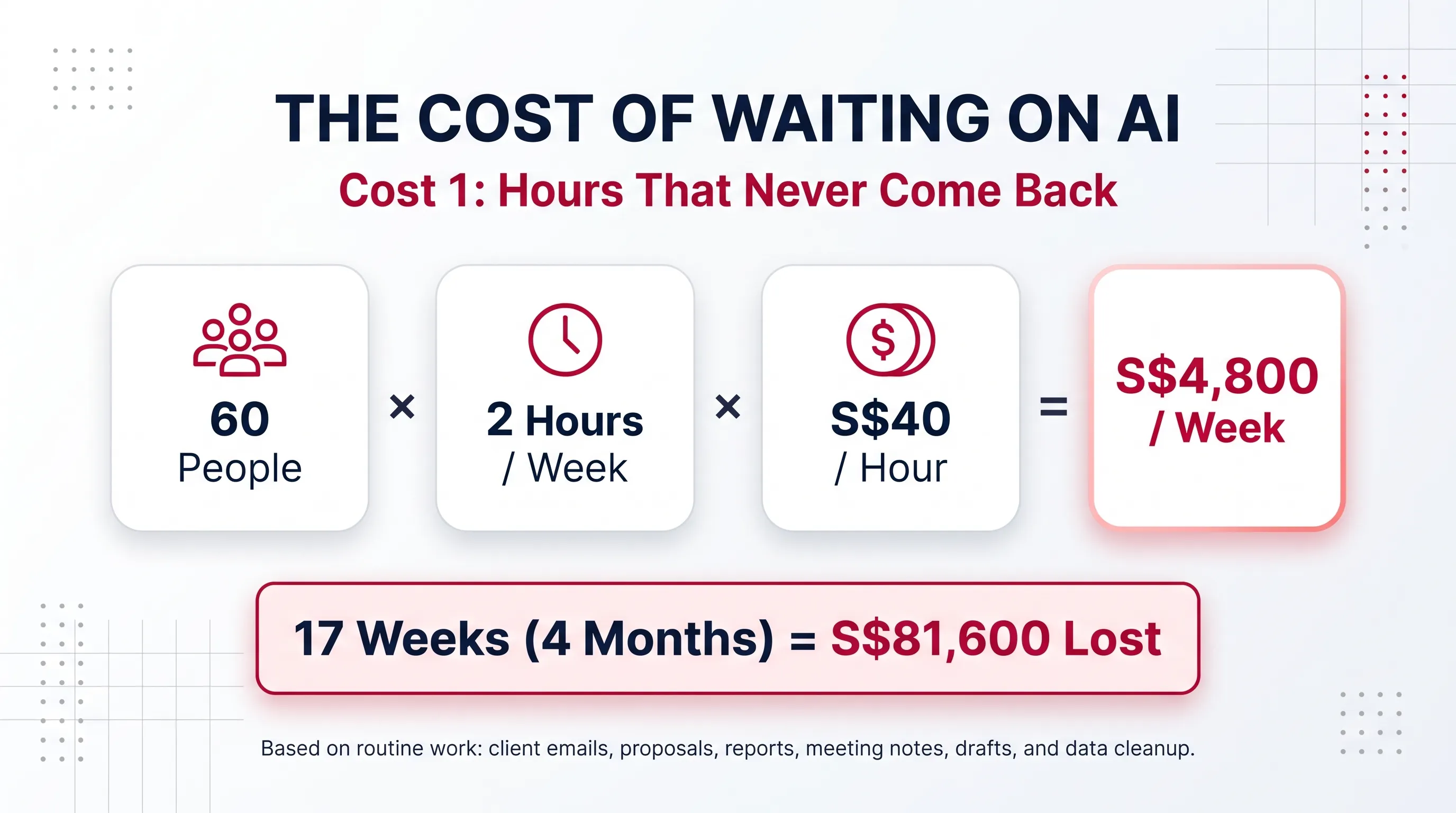
Cost 1: Hours that never come back

Start with time, because it is the easiest to count. Pick the roles where AI can plausibly take routine work: client emails, proposals, reports, meeting notes, first drafts and data cleanup. For each role, estimate three things. How many people are in it. How many hours a week AI could realistically return to each of them. What one hour of that person costs you in salary and overhead.

Multiply the three, then multiply by the number of weeks you expect to wait. Here is an example with round numbers. These are assumptions for you to replace with your own, not a benchmark. Say 60 people, 2 hours a week returned to each, and S$40 per loaded hour. That is S$4,800 a week. Wait 17 weeks, about four months, and the cost is roughly S$81,600.

Two cautions keep this honest. Returned hours only count if they move to work that matters, so treat the figure as a ceiling, not a forecast. And the skills that return those hours are specific to each role, which is the focus of AI productivity training, not a count of software licences.

Cost 2: Use that nobody guides

Waiting does not stop AI use. It only removes your say in how it happens. Bitdefender's 2026 Cybersecurity Assessment, a survey of 1,200 IT and cybersecurity professionals across six countries and reported by Fintech News Singapore in July 2026, found that only 48% of Singapore organisations had full visibility into the AI tools and language models their employees use for work. Half had partial visibility, covering official tools but not personal accounts or shadow AI subscriptions.

Our view is that the answer is not a ban. A ban tends to push use out of sight. The answer is a short set of usage rules, plus training that shows people what is safe to put into a tool and what is not. Every month without that is a month of habits forming with no guardrails, and the cost can show up late, as a data incident, a wrong figure sent to a client or a quality problem nobody can trace.

Cost 3: Pilots that stall and restart

A failed first attempt is expensive because it makes the second attempt harder to approve. Salesforce research on more than 1,500 desk workers, reported by Techgoondu in July 2026, found that 31% of Singapore respondents had run an AI pilot that did not succeed. Among those respondents, the most common reasons were generic outputs (40%), lack of trust in outputs (38%) and insufficient business context (30%). The same study found that just 6% of Singapore desk workers say AI is a key part of their daily work.

Notice what the reasons have in common. Generic output and missing context are about how people prompt, what they feed in and how well they know their own work. That is a skills and context problem. Our reading is that a pilot without role-level training is likely to fail for exactly these reasons, and a failed pilot then becomes the story a firm tells itself about AI. If you are deciding how much to spend and what to look for, our buyer's guide on what to read before you spend on AI training covers the other side of the table.

Cost 4: Decisions that keep slipping

The last cost is the hardest to see. When leaders are unsure how much they need to know about AI, decisions get deferred: which use cases come first, who owns them, what data can be used. Each deferral hands more influence to vendors and to whichever team pushes hardest. The cost is a strategy set by default.

This is the ground that AI leadership training is meant to cover for senior teams, and that AI strategy training addresses when the question is which opportunities to prioritise and how to tie them to business value.

Adding it up

Put the four lines together and you have an honest estimate. Most leaders find the first line alone is large enough to justify a small, well-run start. The other three are harder to put a number on, which is not a reason to treat them as zero.

See how our AI programmes build role-level skills your people use every day.

What should a mid-size firm do instead of waiting?

The alternative to waiting is not a large programme signed in a hurry. For most mid-size firms the smarter move is a small, structured start, and a small start needs only three things.

Pick two workflows, not twenty tools

Choose one that touches revenue, such as proposals or client follow-up, and one that is routine admin, such as reporting or meeting notes. A narrow scope makes results visible within weeks and keeps the conversation about work, not software.

Write the rules before the rollout

One page is enough: which tools are approved, what data must never be entered, and who to ask when unsure. This answers cost two directly, and it gives any training something concrete to teach.

Train for the role, then measure

Train managers and one pilot team on their own workflows, using their own documents and tasks. That is how we approach it at Global Brand Academy: programmes are customised to a team's experience, tools and tasks, and learning goals are agreed before anything is recommended. If you want a sequence to follow, our article on how to train employees on AI in Singapore sets out Dr Jerome Joseph's 4E framework: Explore, Experiment, Embed and Elevate.

Train for the role, then measure

Then measure the results. Track hours returned and where they were redirected, the quality of the output, and whether use stayed within your rules. Most teams skip the baseline, which makes any result impossible to prove, so record where you start. Our guide to ways to measure training ROI shows how to do that without a finance team.

A note on funding

Support exists for some employer-sponsored training in Singapore, and it always depends on the programme and on who attends. Our SkillsFuture funding guide lists which of our programmes sit under WSQ and notes that funding is subject to programme and participant eligibility. Check the specific programme before you budget around a subsidy.

Where does AI fit with the skills a firm already needs?

We do not treat AI as a gimmick or a standalone skill. It amplifies what a business already needs: selling with credibility, leading with clarity and building a brand people trust. A team that cannot explain its offer clearly will simply produce generic copy faster. A team that can, and learns to apply AI inside its own craft, gets better work at greater speed.

That is why we focus on capability rather than content, and on using AI without losing the human edge. It is also why future of work training sits alongside the tools. Roles are changing, not just tasks, and MOM's report points the same way: firms are redesigning roles (18.9%) and creating new AI-related jobs (13.9%), while reduced headcount was reported by only 6.2%.

The practical point for a leader is simple. The firms that start well are not the ones with the biggest budgets. They are the ones that put a price on waiting, pick a small first step, and give their people the skills to use AI on work that matters.

Frequently Asked Questions

How many Singapore firms have adopted AI?

In MOM's 2026 survey, 28.5% of firms had started adopting AI and 71.5% had not. Adoption rises with size: 27.2% for firms with fewer than 200 employees, 54.8% for firms with 200 to 500, and 76.4% for firms with more than 500.

Is it too late for a mid-size firm to start with AI?

No. Most Singapore firms are still at an early stage, with only 28.5% having started adopting AI. The risk is not arriving late to the start. It is staying late while peers build skills. A focused first step on two workflows is enough to begin.

What are the biggest barriers to AI adoption in Singapore?

MOM found that high implementation cost (44.9%) and lack of in-house expertise (42.4%) were the top barriers across all firms. Smaller firms also cited lack of strategy (32.4%) and low trust in AI (30.8%), while larger firms cited integration complexity (56.1%) and data security (55.4%).

How do I estimate the cost of waiting on AI?

Multiply the people in a role by the hours AI could return to each of them every week, then by their loaded hourly cost, then by the weeks you expect to wait. Repeat for your main roles and add the results. Treat the total as a ceiling, because returned hours only count if they go to useful work. Then consider unguided use, stalled pilots and slow decisions separately.

Do we need to hire AI specialists before training our staff?

Not as a first step. Training existing managers and teams on their own workflows builds the in-house expertise that MOM's barrier data says many firms lack. Specialists matter more later, when integration and data security become the main issue, which MOM found is especially true for larger firms.

Is funding available for AI training in Singapore?

Some employer-sponsored training in Singapore can qualify for government support, but eligibility depends on the programme and on who attends. Global Brand Academy's SkillsFuture funding guide lists its WSQ programmes and states that funding is subject to programme and participant eligibility. Check the specific programme before budgeting around a subsidy.

Dr. Jerome Joseph - Recognized #2 Global Brand Guru

Dr. Jerome Joseph

Singapore-Based Global Keynote Speaker | Corporate Trainer |
Brand & AI Expert

LinkedInX (Twitter)YouTubeSpotifyFacebookTikTok

Dr. Jerome Joseph is a Singapore-based global keynote speaker, corporate trainer, brand strategist, AI and business transformation expert, and best-selling author.

With more than 30 years of experience, he has worked with over 1,000 brands across 41 countries, helping leaders, organisations and professionals strengthen their brands, embrace AI and improve business performance.

Ranked No. 2 in the world as a Global Brand Thought Leader in 2020 and 2022, Dr. Jerome is a former CEO and Board Member of a publicly listed brand agency, the author of 14 books, a Certified Speaking Professional (CSP), Global Speaking Fellow (GSF), and the youngest inductee into the Asia Speaker Hall of Fame.

He delivers international keynotes, corporate training and advisory programmes in AI, sales, branding, personal branding, leadership and customer experience.

Explore Dr. Jerome Joseph's keynotes, training and advisory programmes at website.

GET IN TOUCH WITH GLOBAL BRAND ACADEMY

Connect with Global Brand Academy for training, transformation, or strategic support, and build capabilities across brand, leadership, culture, sales, customer experience, and AI while bridging learning with real-world performance.

HOW CAN WE HELP YOU?

Let's Collaborate to Inspire, Transform, and Elevate Your Event, Organisation or Team.

Singapore
+65

Related Posts