Logo
AI & Digital Transformation

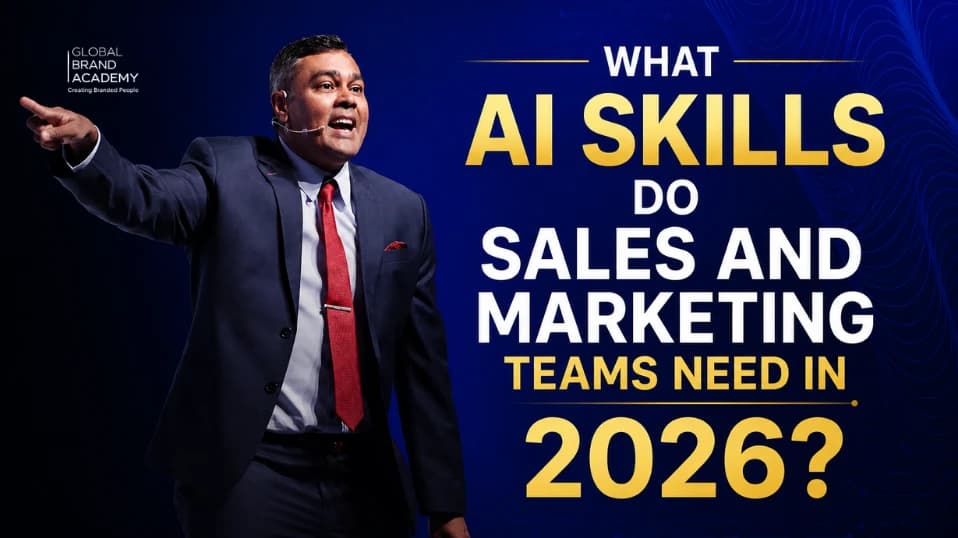
What AI Skills Do Sales and Marketing Teams Need in 2026?

Published on August 31, 2026By Team Dr. Jerome Joseph
What AI Skills Do Sales and Marketing Teams Need in 2026?

AI is no longer something only technology teams need to understand. Sales and marketing teams are already seeing AI change how they research customers, create content, manage leads, communicate with prospects and make decisions.

But there is an important difference between having access to AI tools and knowing how to use AI well.

A team can have access to several AI platforms and still struggle to get useful results. The real advantage comes when people understand what AI can do, where it fits into their work and where human judgement is still needed.

For businesses planning their next stage of growth, the question is no longer simply whether employees should use AI. The better question is:

What AI skills should sales and marketing teams develop in 2026?

AI Literacy Is the Starting Point

The first skill teams need is basic AI literacy. Employees should understand what AI can and cannot do, how to write useful instructions, how to check the quality of an output and when human review is necessary. AI literacy does not mean everyone needs to become a technical expert. Salespeople and marketers need enough understanding to use AI confidently and responsibly in their everyday work.

This includes:

  • Understanding common AI capabilities

  • Writing better prompts

  • Checking AI-generated information

  • Protecting sensitive business information

  • Knowing when human judgement is required

  • Using AI responsibly

Without this foundation, teams may use AI frequently without actually becoming more effective.

Build AI-ready sales and marketing teams with practical skills that drive better business results.

1. Customer and Market Research

Good sales and marketing start with understanding the customer. AI can help teams organise information, identify patterns, summarise research and explore customer questions more quickly. But the skill is not simply knowing which AI tool to open.

1574069743304

Teams need to learn how to ask better questions and turn AI-assisted research into useful business insight. For example, marketers can use AI to explore customer themes and content opportunities, while sales teams can use it to prepare for conversations and understand prospect needs.

The goal is not to let AI make the decision. The goal is to help people reach better decisions with better information.

2. AI for Content and Marketing Workflows

Content remains an important part of modern marketing, but creating useful content at scale can take significant time.

AI can support research, idea generation, content planning, editing and personalisation. Teams therefore need to understand how to build practical AI workflows instead of simply asking AI to "write something." This is where structured prompting becomes valuable.

A strong workflow might look like:

Research → Plan → Create → Review → Improve → Publish

The human still controls the message, brand voice, accuracy and final quality. Businesses interested in developing deeper marketing capability can also explore an AI digital marketing course in Singapore that focuses on practical application rather than AI theory alone.

3. AI-Enabled Sales Skills

Sales teams can also use AI across different stages of the customer journey. AI can support prospect research, lead qualification, sales preparation, follow-up, customer communication and knowledge management. But effective AI sales skills require more than knowing how to automate a task.

Sales professionals still need to understand customers, build trust, ask good questions and communicate value clearly. AI should help them spend less time on repetitive work and more time on meaningful conversations.

This is particularly important as businesses increasingly explore AI sales training in Singapore to help sales teams adapt to new ways of working.

4. Prompting and Practical AI Workflows

Prompting is becoming a useful workplace skill because the quality of an AI response often depends on the quality of the instruction. Sales and marketing teams should learn how to give AI enough context, explain the desired outcome and provide clear constraints.

Instead of:

"Write a sales email."

A better instruction might explain the audience, purpose, tone, customer situation and desired next step. The result is usually more useful because the AI has a clearer task. But prompting should not become an end in itself. The real objective is building repeatable workflows that save time and improve work quality.

Help your team turn AI from a tool into a practical part of everyday sales and marketing.

AI for Sales Productivity

Sales teams spend a lot of time on research, meeting preparation, notes and follow-ups. AI can reduce some of this repetitive work and give salespeople more time for customer conversations. For example, AI can help prepare for a meeting, organise customer information or create a follow-up draft. The salesperson still reviews and improves the final output.

1770314278164

AI and Customer Personalisation

Customers expect communication that feels relevant to their needs. AI can help sales and marketing teams understand customer interests, create more relevant content and support personalised communication. But good personalisation still depends on human understanding. AI can process information quickly, while people decide what actually matters to the customer.

Human Skills Still Matter

AI should support people, not replace the skills that make sales and marketing effective.

AI can support

People provide

Research

Customer understanding

Content ideas

Brand judgement

Data analysis

Business decisions

Sales preparation

Relationship building

Automation

Accountability

The strongest teams will combine AI capabilities with communication, creativity, judgement and empathy.

Responsible AI Use

Teams also need to understand how to use AI safely. This includes protecting sensitive information, checking AI-generated content and knowing when human review is required. Responsible AI use should become part of everyday training, especially for teams working with customer and business information.

Build Skills, Not Just Tool Knowledge

Businesses do not need their sales and marketing teams to learn every new AI tool. They need people who understand where AI can create value and how to use it effectively. The focus should be on practical skills such as AI literacy, customer insight, prompting, sales productivity, marketing workflows and responsible AI use.

The goal is simple: use AI to help people work smarter, make better decisions and create more value for customers.

FAQ

What AI skills do sales and marketing teams need in 2026?

Sales and marketing teams need practical skills such as AI literacy, prompting, customer research, content workflows, sales productivity, personalisation, responsible AI use and AI adoption.

Do salespeople need technical AI skills?

No. Salespeople do not need to become AI engineers. They need enough AI knowledge to use relevant tools, create useful workflows and understand when human judgement is required.

How can AI help sales teams?

AI can support prospect research, sales preparation, lead qualification, customer insight, follow-ups and repetitive administrative work. Human relationship building and decision-making remain important.

How can AI help marketing teams?

AI can support research, content planning, content creation, customer insight, personalisation and workflow automation. Teams still need to review quality, accuracy and brand relevance.

Why is AI literacy important for employees?

AI literacy helps employees understand what AI can do, how to use it responsibly and how to check its output. It also helps organisations build more consistent AI adoption across teams.

Should businesses provide AI training for sales and marketing teams?

Yes, when AI is becoming part of everyday work. Practical training can help teams identify useful AI use cases, build workflows, improve productivity and adopt AI responsibly.

Related Posts