Walk into almost any sales floor in Singapore today and you will find AI already at work. Prospecting tools are scoring leads before a rep even opens their laptop. Forecasting dashboards are flagging deals at risk. Email assistants are drafting the first pass of every follow up. According to Salesforce's State of Sales report for ASEAN, 80 percent of Singapore sales professionals now use some form of AI for daily tasks such as prospecting, forecasting, lead scoring, and drafting emails, and 98 percent say AI actively increases their odds of hitting sales targets.
On paper, that looks like a solved problem. In practice, sales leaders across Singapore keep asking a version of the same question: if adoption is this high, why are so many pipelines still underperforming?
What Is AI Sales Software, Exactly?
AI sales software refers to any tool that uses machine learning or generative AI to support part of the sales process, from finding and qualifying leads, to personalising outreach, to forecasting revenue, to coaching reps after a call. It sits across four broad categories that most Singapore sales teams will recognise:
Category | What It Does |
|---|---|
Prospecting and lead generation | Surfaces and scores potential buyers before a rep makes contact |
Productivity and automation | Drafts emails, summarises calls, and updates CRM records automatically |
Conversation intelligence | Analyses sales calls and flags coaching moments |
Forecasting | Uses historical data to predict which deals are likely to close |
The Global Brand Academy team has covered how these categories are reshaping the wider function in a closer look at AI's impact on sales and marketing, and the pattern is consistent across industries: the tools themselves are maturing faster than most organisations' ability to use them well.
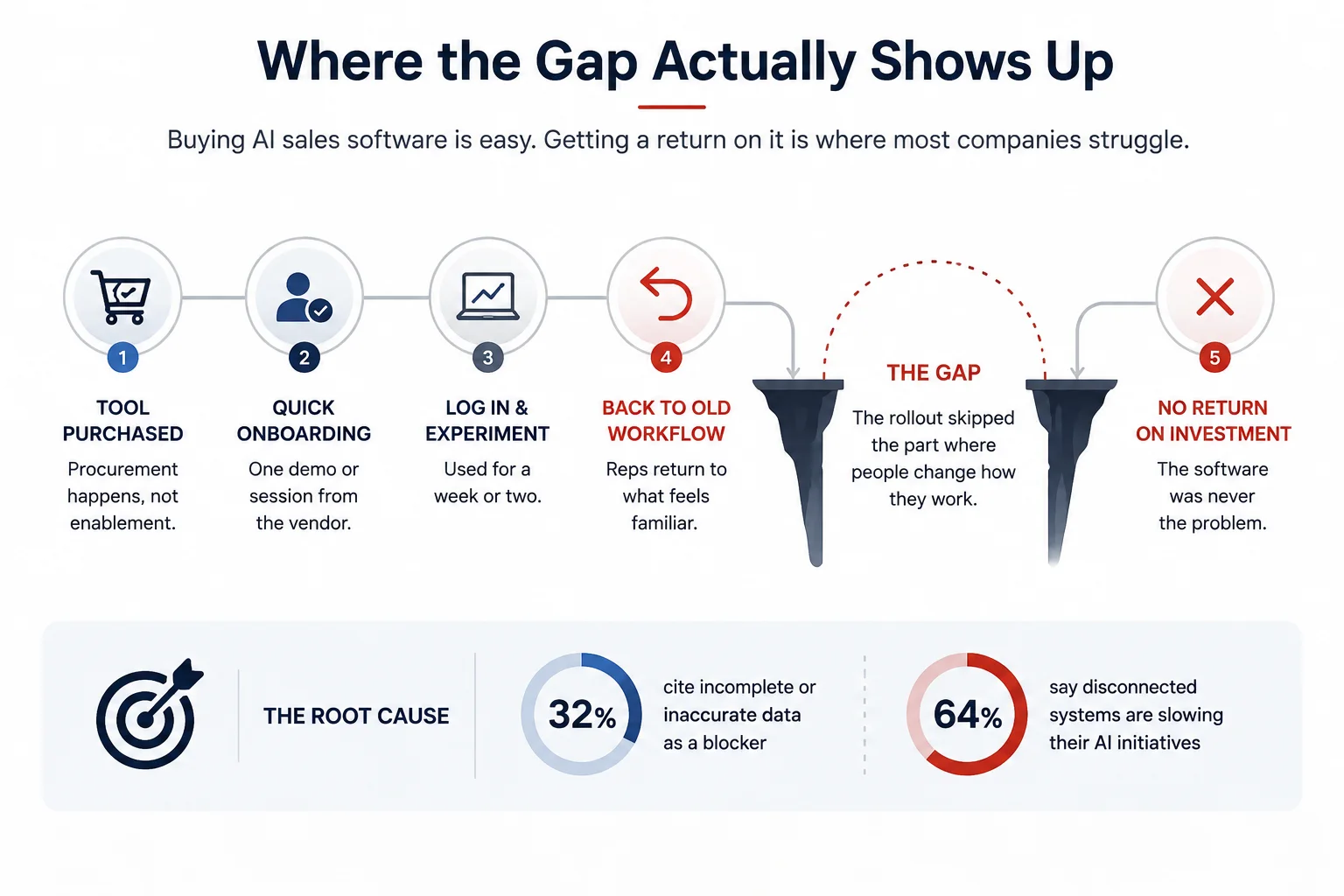
That gap between buying software and actually working differently because of it is where most of the lost revenue sits.
The Real Story Behind the Adoption Numbers
The regional data backs this up in a way that is hard to ignore. Globally, 57 percent of B2B companies have now deployed AI in at least one part of their sales process, and the payoff for the ones doing it properly is real: teams using AI report 76 percent higher revenue growth, and AI-using reps exceed quota at a rate of 83 percent compared to 66 percent for reps not using AI.
But sit with the other half of the Salesforce ASEAN data for a moment.
Singapore Sales Data Point | Figure |
|---|---|
Sales professionals using AI daily | 80% |
Say AI increases their odds of hitting targets | 98% |
Say traditional sales enablement does not meet their skill needs | 66% |
Say remote or hybrid work cuts them off from peer learning | 71% |
Say they rarely get feedback on real sales conversations | 58% |
More likely top performers are to use prospecting AI agents than underperformers | 1.7x |
Source: Salesforce State of Sales, ASEAN edition, 2026.
Top performing reps being 1.7 times more likely than underperformers to use prospecting AI agents tells you the tool was never the differentiator on its own. It was always what the rep already knew how to do with it.
Put simply: Singapore sales teams are not short on AI software. They are short on the capability to turn that software into a repeatable, coachable way of selling. That is a training and enablement problem wearing a technology disguise, and it is exactly the gap that determines whether a sales transformation effort actually shows up in the quarterly numbers or quietly stalls after the first few weeks of enthusiasm. It also mirrors what the Global Brand Academy team has consistently found when working with sales organisations on what actually makes a high performance sales team in 2026, where strategic AI use is only one of seven traits, never the whole answer on its own.
.webp "The Gap Is Closing (1)")