Logo
AI & Digital Transformation

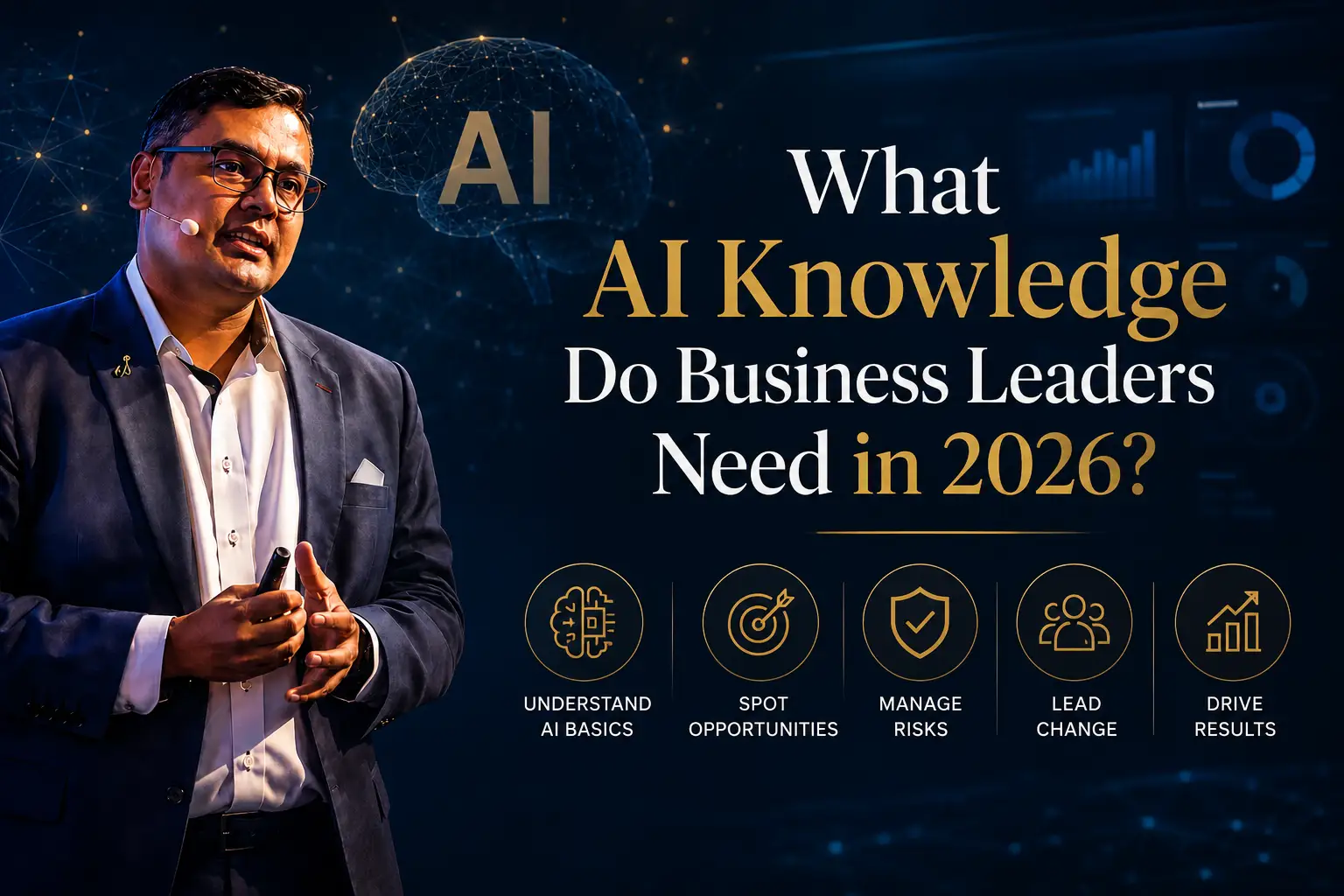
What AI Knowledge Do Business Leaders Need in 2026?

Published on August 23, 2026By Team Dr. Jerome Joseph
What AI Knowledge Do Business Leaders Need in 2026?

Do Business Leaders Really Need to Understand AI?

AI has moved from being a technology conversation to a business conversation. Today, leaders are asking questions such as: Should we invest in AI tools? Should we train our employees? Which tasks should we automate? How much should we spend? Can AI improve sales or customer experience? What risks should we be worried about?

These are not technical questions alone. They are leadership questions. This is why business leaders need AI knowledge, but they do not necessarily need deep technical skills.

A CEO does not need to become a data scientist. A business owner does not need to learn how to build a large language model. A senior executive does not need to understand every technical detail behind every AI platform.

What they do need is business-level AI literacy.

"The goal is not to make every leader an AI engineer. The goal is to help leaders make better decisions in a business where AI is becoming part of everyday work."

This difference matters.

A leader with the right level of AI knowledge can ask better questions, challenge weak assumptions, identify useful opportunities and avoid spending money on technology simply because everyone else is using it.

Global Brand Academy's approach to AI capability also focuses on AI literacy, responsible use, AI-supported decision-making and connecting AI to real business outcomes rather than treating technology as the goal itself. This fits with the wider shift from simply learning about AI to building practical AI capability across an organisation.

What Is the Right Level of AI Knowledge for a Leader?

The right level is not the same for every leader.

A technology company CEO may need more technical understanding than the owner of a retail business. A CFO may need deeper knowledge of AI-related costs and risk. A marketing leader may need more knowledge about AI tools, customer data and content workflows.

However, most business leaders should understand five basic areas:

  1. What AI can do

  2. What AI cannot do

  3. Where AI can create business value

  4. What risks AI creates

  5. How to decide whether an AI investment is worth it

These areas create a strong foundation without forcing leaders to become technical specialists. The mistake is thinking that AI knowledge means knowing every new tool.

There are hundreds of AI tools available today, and new ones appear constantly. A leader who tries to keep up with every tool will quickly become overwhelmed. Instead, leaders should understand the principles behind the technology and how those principles connect to their business.

The Five Questions Behind Good AI Leadership

Business question

What the leader needs to understand

What can AI do?

The main capabilities and practical uses of AI

Where can AI help us?

The business problems where AI may create value

Where can AI fail?

Accuracy, data, privacy, bias and other risks

What should we invest in?

Cost, expected value, readiness and business impact

How should we lead it?

People, skills, adoption, accountability and change

This is a more useful way to think about AI knowledge than trying to measure how technical a leader is.

AI Knowledge Should Start With Business Problems

One of the biggest mistakes companies make is starting with the technology. They discover a new AI platform and then ask, "How can we use this?" A better question is:

"What business problem are we trying to solve?"

For example, a sales team may spend hours researching prospects and preparing proposals. AI may help reduce that workload. A customer service team may answer the same questions repeatedly. AI may help improve response speed and consistency. A leadership team may spend too much time collecting information before making decisions. AI may help organise and analyse information faster.

The technology comes second. The business problem comes first.

This is also why AI training should focus on real workplace problems instead of simply teaching employees how different tools work. GBA's AI capability framework follows this practical approach by connecting AI with marketing, sales, productivity, leadership, decision-making and change management.

Build the AI knowledge your leaders need to make better business decisions.

The Five Levels of AI Knowledge Every Business Leader Should Understand

A simple way to think about AI leadership is through five levels. These levels are not about becoming more technical. They are about becoming more capable of making good decisions with AI.

Level 1: AI Awareness

At the first level, leaders should understand what AI is and what it is changing. They should know the difference between generative AI, automation, AI assistants and traditional software. They should also understand that AI can produce useful answers while still making mistakes.

This level helps leaders avoid two common problems: fear and overconfidence. Some leaders think AI will replace everything. Others think AI is just another software trend.

Neither view is useful. A good leader understands both the opportunity and the limits.

The purpose of AI awareness is not to turn leaders into technical experts. It is to give them enough understanding to have useful conversations with technology teams, employees, vendors and other decision-makers.

Level 2: AI Use

Leaders should know how AI can support their own work.

This could mean using AI to prepare meeting summaries, organise information, research markets, create early drafts, compare ideas or support planning. The important part is not the number of tools a leader knows. It is whether the leader has enough hands-on experience to understand how AI behaves in real work.

When leaders use AI themselves, they quickly learn an important lesson: AI can save time, but human judgement still matters. This experience is valuable because employees pay attention to what senior leaders actually do.

If leaders talk about AI but never use it, employees may see AI as another temporary initiative. If leaders use AI responsibly, discuss what worked and openly acknowledge its limitations, teams are more likely to take adoption seriously.

Global Brand Academy's AI adoption material also highlights leadership behaviour as an important part of successful AI adoption.

Level 3: AI Decision-Making

This is where AI knowledge becomes especially important for senior leaders.

A business leader does not need to understand every technical feature of an AI system. They need to know how to evaluate a decision.

Imagine a company is considering a major AI investment. The important question is not simply whether the technology is impressive. The important question is whether the investment solves a real business problem and creates enough value to justify the cost and risk.

A strong leader should therefore be able to ask questions such as:

What problem will this investment solve?

How often will the team use it?

What will it save us?

What new risks will it create?

What data will it need?

Who will be responsible for it?

How will we measure success?

These questions matter more than knowing every technical detail of an AI platform.

This is especially relevant to the search behaviour already appearing in GSC around the right level of technical understanding for business leaders making AI capital allocation decisions. The existing query is currently receiving impressions, which suggests Google is already testing GBA's relevance for this type of leadership question.

Level 4: AI Risk and Responsibility

AI can create business value, but it can also create new risks. Leaders should understand the main areas that need attention, including data privacy, confidential information, accuracy, bias, intellectual property, security, human oversight and accountability.

They do not need to become legal or technical specialists in every area.

But they need to know when specialist advice is required.

This is an important part of AI leadership because the cost of a bad AI decision is not always financial. A poorly managed AI system can affect customer trust, employee confidence, business reputation and the quality of important decisions.

"Leaders do not need to know every answer. They need to know which questions must be asked before a decision is made."

That is especially important when AI is used with customer data, financial information, employee information or other sensitive business data.

Level 5: AI Strategy

The highest level is understanding how AI connects with the wider business strategy. This means asking:

"If AI changes the way we work, what should our organisation look like two or three years from now?"

That question is much bigger than choosing an AI tool. It involves people, processes, skills, customer experience, productivity, innovation and competitive advantage. A business may adopt several AI tools and still fail to create meaningful change. Another organisation may use fewer tools but create much greater value because its leaders know exactly where AI fits into the business.

This is why AI strategy should connect technology with clear goals, human judgement, responsible use and accountability. GBA's 2026 strategy guide makes the same point: AI capability should complement human judgement rather than replace clear objectives, domain knowledge and accountability.

What Business Leaders Do Not Need to Learn

This is equally important. Many leaders waste time trying to learn things they do not actually need for their role.

Unless AI technology is central to their business, most CEOs and business owners do not need to become machine learning engineers, learn every AI platform or understand every algorithm behind modern AI systems.

Those skills can be valuable for specialists. Leadership requires something different. A business leader needs to understand enough AI to decide where to use it, where not to use it, what to invest in, what to measure and when to involve experts.

This is the difference between AI expertise and AI leadership literacy. The first requires deep technical knowledge. The second requires strong business judgement supported by a practical understanding of AI.

AI Knowledge Should Lead to Better Decisions

AI Knowledge Should Lead to Better Decisions

Business leaders need practical AI knowledge that helps them understand where the technology can create value and how it can support better business decisions.

  • Identify where AI can create meaningful business value.
  • Understand AI limitations, risks and responsible use.
  • Evaluate AI investments based on business goals.
  • Guide teams towards practical AI adoption.

With the right level of AI literacy, leaders can ask better questions, guide their teams with confidence and make informed decisions about productivity, customer experience and business growth.

Turn AI Learning Into Business Capability

Turn AI Learning Into Business Capability

Sustainable AI adoption starts when leaders connect learning with real business needs and help their teams use AI in practical and responsible ways.

  • Support continuous AI learning across the organisation.
  • Apply AI to real workplace challenges.
  • Build responsible processes for AI use.
  • Measure the impact on productivity and performance.

The goal is not simply to learn different AI tools, but to build the confidence, skills and processes needed to turn AI learning into lasting business capability.

Move from AI awareness to practical business capability across your organisation.

How Much Should a Business Leader Invest in AI Knowledge?

The answer should depend on the business, not the hype.

Before investing in a large AI programme, leaders should look at business value, organisational readiness and risk. These three areas provide a simple starting point for deciding whether more AI learning, new tools or a larger transformation programme is needed.

Area

The question leaders should ask

Business value

What real problem will AI solve?

People

Do our teams have the skills to use it?

Process

Are our current workflows ready for AI?

Data

Do we have the right information and controls?

Risk

What could go wrong?

Measurement

How will we know it worked?

Leadership

Are senior leaders ready to support adoption?

This approach helps companies avoid a common mistake: buying technology before preparing the organisation. A company may have excellent AI software and still see little value if employees do not know how to use it, managers do not support adoption or workflows are not designed for the new technology. That is why AI knowledge should not sit only with the IT team. Leaders, managers and business functions need enough understanding to connect AI with their own responsibilities.

The Best AI Leaders Are Not Always the Most Technical

There is a common belief that the best AI leader must be the most technical person in the room. That is not always true. A strong AI leader may not understand every technical detail, but they know how to connect technology with business goals.

They can ask the right questions. They can bring technology, people and strategy together. They can recognise when an AI project is useful and when it is simply expensive experimentation. They can also create an environment where employees feel comfortable learning and testing new ways of working.

This is why AI leadership is closely connected to change management. Training people once is not enough. Organisations need leadership involvement, practical use, continuous learning and measurement of business outcomes. Global Brand Academy's AI adoption framework also highlights the importance of leadership commitment, practical implementation and continuous learning.

If your organisation is already investing in AI training, it is also worth asking whether employees are actually applying what they learn. The difference between corporate AI training and lasting AI capability is often what happens after the training session.

A Simple AI Knowledge Test for Business Leaders

Here is a practical test for CEOs, founders and senior leaders.

Ask yourself these questions:

  1. Can I explain in simple words what AI can and cannot do?

  2. Can I identify three business problems where AI could create value?

  3. Can I explain how we would measure the return on an AI investment?

  4. Do I understand the main risks of using AI in my organisation?

  5. Do I know which business data should not be shared with AI tools?

  6. Can I explain how AI could change the way our teams work?

  7. Can I make an informed decision about when we need an AI specialist?

If you can confidently answer most of these questions, you probably have a good foundation. If you cannot, that does not mean you need to become technical. It means your next step should be better business-focused AI learning. For organisations looking at the practical side of AI capability, AI training for corporate teams can help connect AI learning with workplace application.

The Real Question Is Not "How Much AI Do I Know?"

The better question is:

"Can I make good business decisions in a world where AI is changing how work gets done?"

That is the level of knowledge leaders should aim for. AI is moving quickly, but leadership principles remain simple. Know the business problem. Understand what the technology can do. Understand where it can fail. Protect your people and data.

Measure the outcome.

Keep learning.

"You do not need to become the smartest AI person in your company. You need to become the leader who knows how to use AI intelligently."

That is a much more useful goal. As AI becomes part of sales, marketing, customer experience, productivity and leadership, the organisations that benefit most will not necessarily be the ones that buy the most tools. They will be the ones that build the strongest ability to connect AI with real business outcomes.

This is also why AI adoption should be treated as an ongoing business capability rather than a one-time training event. GBA's existing AI adoption framework explains that sustainable adoption depends on continuous learning, leadership involvement, practical application and measurement of business outcomes.

Key Takeaway

Business leaders do not need to become AI engineers. They need enough AI knowledge to understand opportunities, challenge assumptions, manage risks, make investment decisions and lead their teams through change. The right level of AI knowledge is therefore business-focused, practical and strategic.

The goal is not knowing everything about AI. The goal is knowing enough to make better decisions.

Frequently Asked Questions

1. Does a CEO need to learn technical AI skills?

No. Most CEOs do not need to become programmers or AI engineers. They need enough AI knowledge to understand opportunities, limitations, risks, costs and business value.

2. What AI skills should business leaders learn first?

Business leaders should start with AI awareness, practical AI use, AI decision-making, responsible AI and AI strategy. These areas help leaders connect technology with business goals.

3. How much AI knowledge does a small business owner need?

A small business owner should understand how AI can improve productivity, customer service, marketing, sales and decision-making. The focus should be on useful applications rather than deep technical knowledge.

4. Should leaders learn AI before investing in AI tools?

Yes. Leaders should have enough knowledge to understand the business problem, expected value, risks and implementation requirements before making a major AI investment.

5. Why is AI knowledge important for business leaders in 2026?

AI is becoming part of everyday business activities, including marketing, sales, productivity, customer experience and decision-making. Leaders need enough understanding to guide adoption and make informed choices.

6. What is the difference between AI literacy and AI expertise?

AI literacy means understanding what AI can do, its limitations, risks and practical business uses. AI expertise requires much deeper technical knowledge. Most business leaders need strong AI literacy rather than technical AI expertise.

Related Posts