What to Do With What You Found
Four actions, in order of value.
1. Fix your own inconsistencies first. This takes a week and costs nothing. One description, one set of numbers, everywhere. Until this is done, everything else is building on sand.
2. Get independent sources to describe you. AI weighs third party mentions far more heavily than your own website. Industry association listings. Trade publications. Podcast appearances. Client case studies published on the client's own site. Speaker directories.
One genuine industry body listing is worth more than fifty directory submissions, because it implies someone checked. This is the same logic that governs whether a corporate brand is believed internally, applied to an external audience that happens to be a machine.
3. Publish something only you have. AI cites what it cannot find elsewhere. Original data from your own work. A framework with a name. Patterns you have seen across clients that nobody else has visibility into.
Generic content gets summarised. Original content gets cited.
4. Show up where people actually ask. If your buyers discuss their problems in a public forum, and nobody from your organisation has ever contributed usefully there, you are absent from a source AI reads heavily.
This has to be genuine participation. Dropping links gets you removed, and removed content helps nobody.
What Not to Bother With
Two things are getting recommended widely and are worth skipping.
Machine readable files aimed at AI crawlers. Google has stated publicly that it does not use these for Search, including AI Overviews and AI Mode. Some other systems do read them. It is a ten minute job with a small payoff, so treat it as optional rather than a priority.
Buying mentions. Paid placements designed to manufacture citations are the modern version of buying backlinks. It worked briefly last time too.
Run This Every Quarter
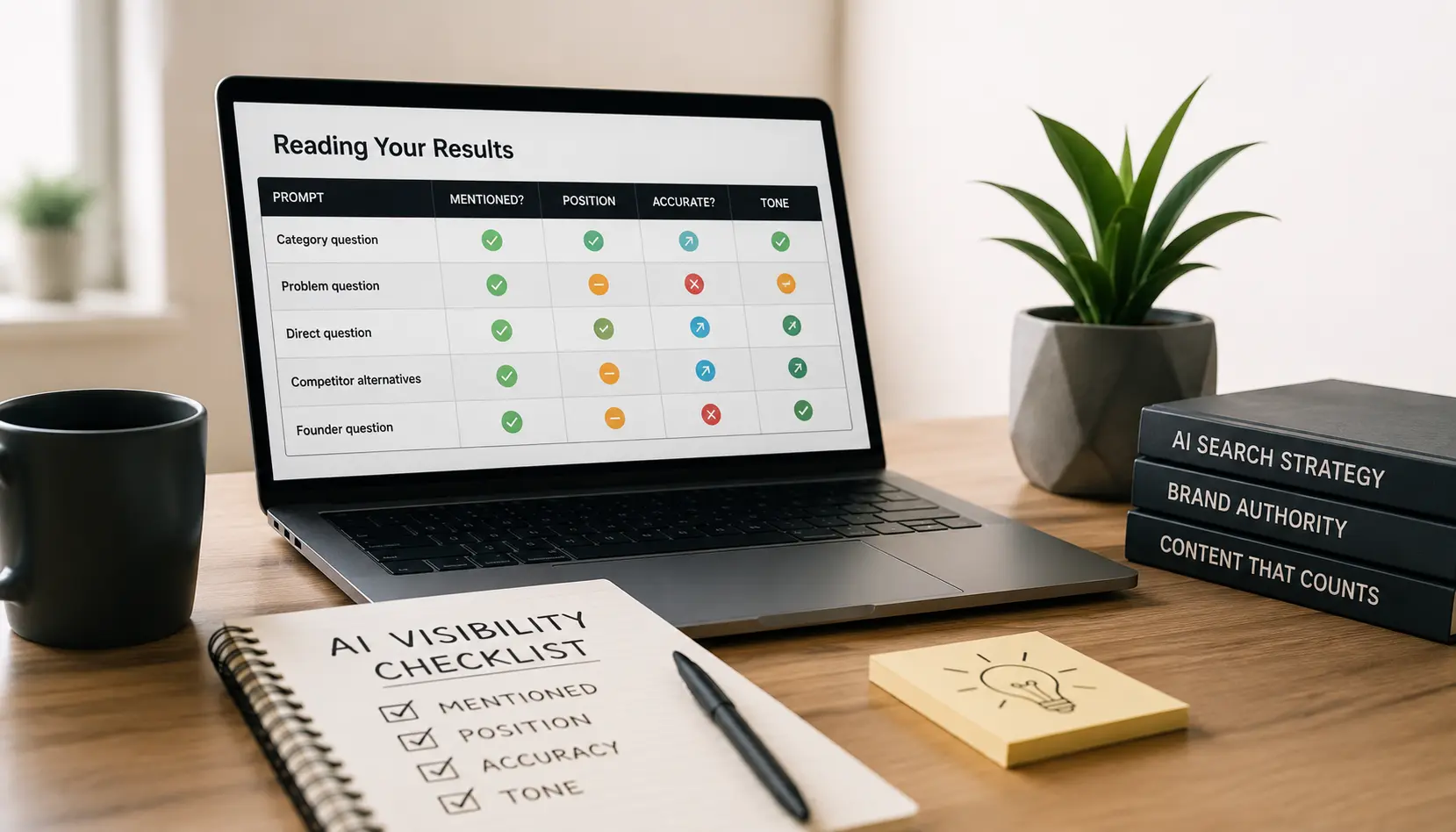
Results shift as models update and as the sources they read change. Keep your grid. Run the same five prompts every three months and compare. You are looking for movement, not perfection. Three things worth tracking each time: whether you appear at all, whether the description is accurate, and which competitors appear alongside you. That third one is often the most useful, because the companies AI groups you with are the companies your buyers are comparing you to, and that list is frequently not the one you expected.
For organisations working through this properly, it usually connects back to positioning rather than promotion, which is where our brand strategy and management work begins.
The Uncomfortable Conclusion
If AI does not mention you, the instinct is to look for a technical explanation. Usually there is not one. Usually it means that not enough credible independent sources have anything specific to say about what you do, and the sources that do exist disagree with each other. That was a brand problem before AI existed. It is simply visible now, and it is visible to your buyer in about four seconds.
About Global Brand Academy
Global Brand Academy is a global strategic training and transformation partner, working with organisations, leaders, executives, sales professionals and entrepreneurs to build capability where it matters most across brand, leadership, culture, sales, customer experience and AI. Built on over 30 years of real world experience across 40+ countries, GBA has served more than 1,000 organisations and impacted over 1.2 million leaders, professionals and entrepreneurs. Our work is anchored around seven transformation domains and delivered through an integrated ecosystem of keynotes, masterclasses, coaching and certification, so learning moves from insight to capability and from intent to impact.
Global Brand Academy is founded and led by Dr Jerome Joseph, an award winning global speaker and author of twelve books, whose doctoral research examined the impact of brand and culture on organisational performance. For organisations discovering that AI describes them poorly or not at all, that background is directly relevant, because the cause is almost always an unclear or inconsistent brand position rather than a technical one.
Frequently Asked Questions
How do I check if AI mentions my brand?
Open ChatGPT, Perplexity, Google AI Mode and Gemini, and run the same five prompts in each. Ask for the best companies in your category and market, describe the problem you solve and ask who to talk to, ask directly what it knows about your company, ask for alternatives to your strongest competitor, and ask about your founder. Record whether you appear, in what position, and whether the description is accurate.
Why does AI not mention my company?
Most often because not enough independent third party sources describe what you do, or because the sources that exist contradict each other. AI systems weigh credible outside mentions more heavily than your own website, and when the available information is inconsistent they avoid stating anything confidently about you.
How do I get my brand mentioned in ChatGPT?
Start by making every description of your organisation identical across your website, LinkedIn, directories and profiles, including all numbers. Then build genuine third party coverage through industry bodies, trade publications, podcasts and client published case studies. Publish original material such as proprietary data or a named framework, since AI cites what it cannot find elsewhere.
Is AI brand visibility the same as SEO?
They overlap and they are not the same. SEO optimises a page to rank. AI visibility depends on how many credible independent sources describe your brand consistently, which is closer to reputation than to page optimisation. Technical fixes help at the margins, but the substantial work is brand and credibility work.
How often should we check AI brand visibility?
Quarterly is sufficient for most organisations. Models update and the sources they draw on shift, so results change over time. Use the same prompts each time so the comparison is meaningful, and track whether you appear, whether the description is accurate, and which competitors appear alongside you.
Does adding an AI text file to my website help?
Google has stated publicly that it does not use such files for Google Search, including AI Overviews and AI Mode. Some other AI systems do read them. It is a small job with a small payoff, so it is reasonable to do but should not be treated as a priority ahead of consistency and third party coverage.