Choosing WSQ Versus Non-WSQ Training
Funding should never be the only reason to select a programme. We have watched organisations choose a heavily subsidised course that had almost nothing to do with their strategy, then wonder why nothing changed six months later.
The honest comparison looks like this.
Consideration | WSQ Programme | Non-WSQ Programme |
|---|
Funding | Subsidies, AP and SFEC available | Usually none |
Credential | National, portable across employers | Provider certificate only |
Assessment | Competency-based, formally assessed | Often attendance-based |
Curriculum | Mapped to national Skills Frameworks | Fully flexible |
Customisation | Structured within the approved framework | Unlimited |
Best suited to | Building verifiable capability at scale | Highly specific or confidential strategic work |
Neither option is superior in the abstract. They solve different problems.
WSQ is the stronger choice when you need consistent, verifiable capability across a group, when the skill maps to a recognised framework, and when funding materially changes what you can afford to do. Our WSQ Sales Training programme sits in exactly that space, where a whole sales team needs the same foundation rather than a few individuals attending separately.
A bespoke, non-funded engagement is the stronger choice when the content involves confidential strategy, a proprietary framework, or a leadership team working on a live business problem that no national framework anticipated. Many of the organisations we work with run both. Funded WSQ builds the base. Custom work builds the edge. If you are weighing that balance for a larger budget, we have written separately about what to check before committing serious money to a training programme.
Five Practical Steps for Employers
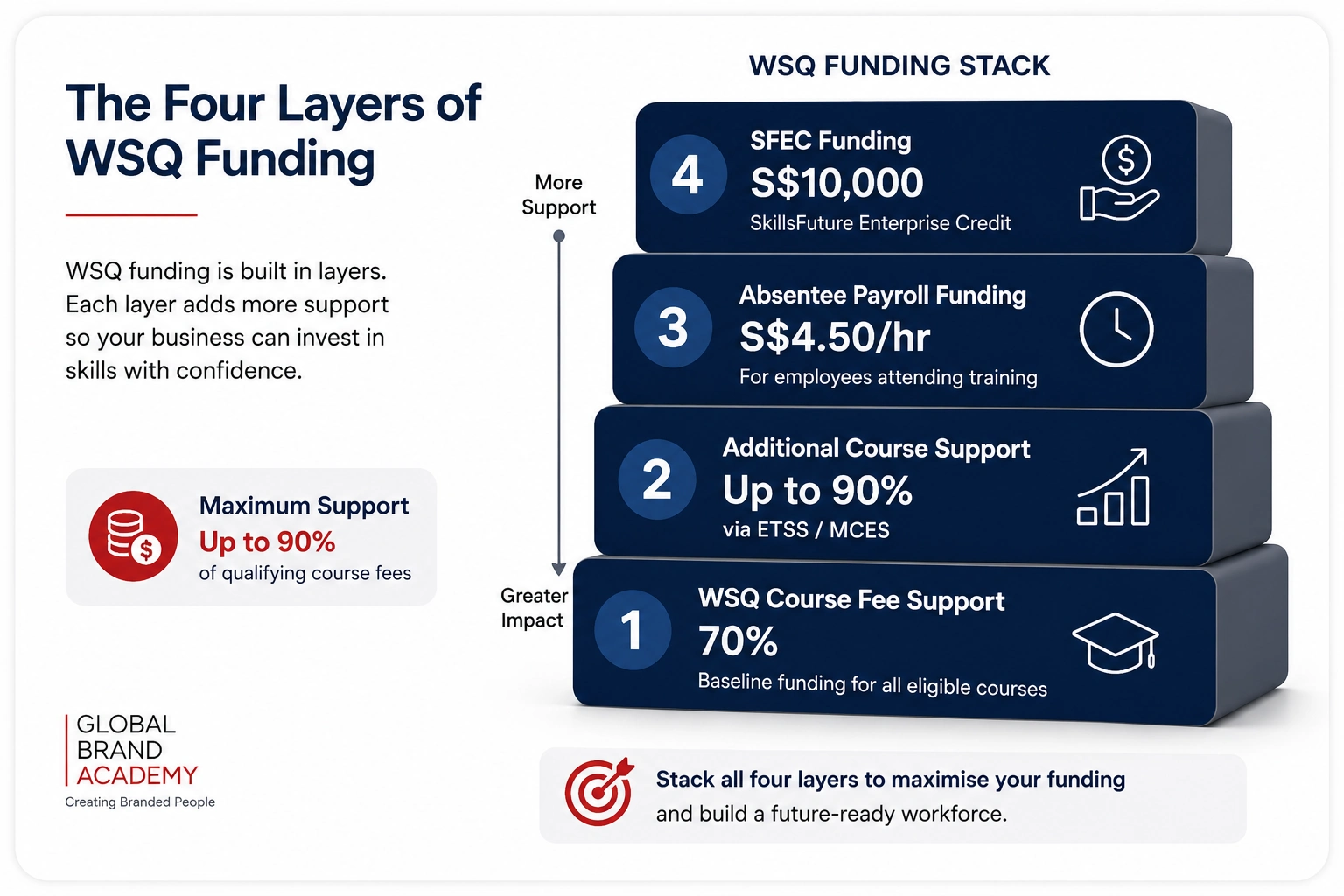
One, confirm your SME status. It is the single biggest swing factor, moving you from up to 70 percent to up to 90 percent. If your status has changed, you must declare it to become eligible for SME rates. Many growing companies never update this.
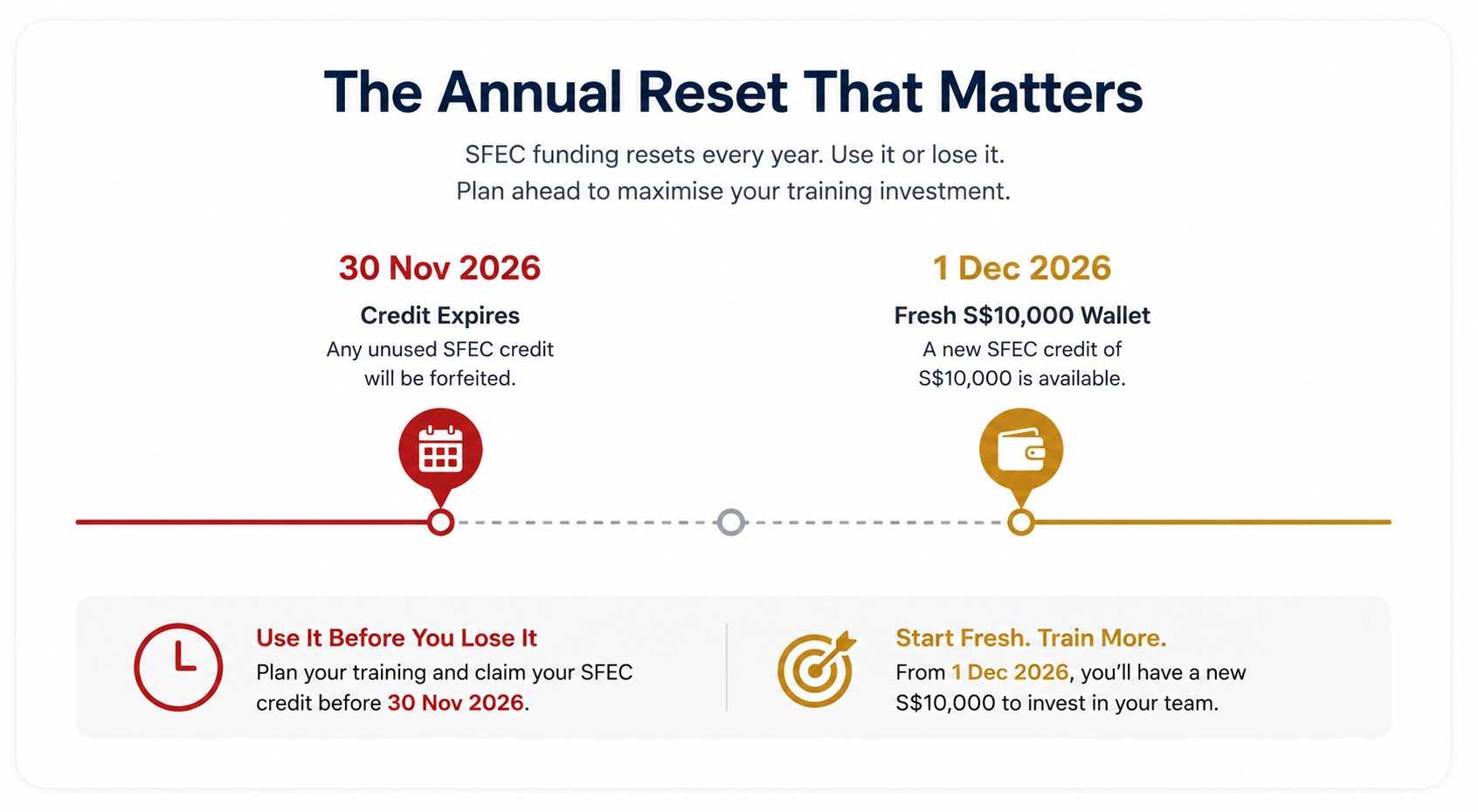
Two, check your SFEC balance now. Not in October. The training itself must be completed on or before 30 November 2026 for the current credit to apply, which means the course needs to be scheduled well in advance.
Three, verify the course is on the SSG directory. Only courses delivered by approved training organisations and listed in the directory attract funding. Ask the provider for the course reference code before you commit.
Four, plan the absentee payroll claim before the course, not after. It requires attendance records. Nominating one person to own the claim removes almost all of the friction that makes companies abandon it.
Five, map the programme to a capability gap, not to a budget line. This is the step that determines whether the investment produces anything. Funding decides what you can afford. Strategy decides whether it was worth affording.
Subsidy improves the economics of a decision. It does not improve the decision.
Where Funded Training Tends to Break Down
We should be candid about the failure mode, because it is common and it is avoidable. An organisation claims the funding, runs the programme, collects the certificates, and nothing measurably changes. Six months later the same capability gap is still there, and the leadership team quietly concludes that training does not work. Training worked. Transfer did not.
Capability transfers when three conditions are met. Managers know what their teams learned and reinforce it. The behaviour is visible in how work is actually done, not just in a post-course survey. And the organisation's internal narrative supports the change rather than contradicting it, which is fundamentally a question of internal branding and culture alignment.
This is why we design programmes around application rather than content delivery. A funded course that changes nothing is still a cost, no matter how small the invoice was. Across our corporate training programmes, the design question is always the same: what will people do differently on Monday.
If you want the wider case for why WSQ suits modern Singapore workplaces specifically, we have covered that ground in more depth in our piece on why WSQ training programmes matter for modern workplaces.
WSQ is not a discount scheme. It is a national capability system that happens to be funded, largely by a levy your company already pays. The organisations that get the most from it treat it as infrastructure. They know their SME status, they know their SFEC balance, they plan training cycles around funding windows, and they choose programmes based on capability gaps rather than availability. The organisations that get the least from it discover the deadline in November.
About Global Brand Academy
Global Brand Academy is a global strategic training and transformation partner, working with organisations, leaders, executives, sales professionals and entrepreneurs to build capability where it matters most: brand, leadership, culture, sales, customer experience and AI. Founded and led by Dr Jerome Joseph, ranked the No. 2 Global Brand Thought Leader in the World in 2020 and 2022 and a best-selling author of 12 books, GBA brings over 30 years of experience across 40+ countries, 1,000+ organisations, and more than 1.2 million leaders and professionals impacted. Our work is anchored in seven transformation domains and powered by proprietary frameworks including The Brand Growth Value Chain and The 5D Framework. As a provider of WSQ programmes across brand, sales and AI-driven marketing, we help Singapore organisations turn funded training into capability that is visible in performance, not just in certificates.
Frequently Asked Questions
What does WSQ stand for?
WSQ stands for Workforce Skills Qualifications. It is Singapore's national, competency-based training and credentialing system, administered under SkillsFuture Singapore. Courses are mapped to national Skills Frameworks and assessed on demonstrated competency rather than attendance.
How much funding can a Singapore employer get for WSQ training?
Employers can access a baseline course fee subsidy of up to 70 percent for Singapore Citizens and Permanent Residents. This rises to up to 90 percent for SMEs under Enhanced Training Support for SMEs, and up to 90 percent for Singapore Citizens aged 40 and above under the Mid-Career Enhanced Subsidy. Absentee Payroll Funding and SkillsFuture Enterprise Credit apply on top.
What is Absentee Payroll Funding and how much is it?
Absentee Payroll Funding reimburses employers for salary costs while employees attend training. It is paid at a fixed rate of S$4.50 per hour of training attended, capped at S$100,000 per enterprise per calendar year. The claim is submitted after the course is completed.
When does the SkillsFuture Enterprise Credit expire?
Unused credit under the current SkillsFuture Enterprise Credit expires on 30 November 2026, and training must be completed on or before that date to qualify. A redesigned SFEC launches on 1 December 2026 under the Enterprise Workforce Transformation Package, giving eligible companies a fresh S$10,000 credit through an online wallet that offsets costs upfront rather than by reimbursement.
Does my company qualify as an SME for enhanced funding?
A company generally qualifies if it is registered or incorporated in Singapore, has at least 30 percent local shareholding, and has either annual turnover of not more than S$100 million or an employment size of not more than 200 people. Companies whose status has changed must declare it in order to become eligible for SME subsidy rates.
Is WSQ training worth it compared to a customised corporate programme?
WSQ is the stronger choice when you need consistent, nationally recognised capability across a group and funding materially expands what you can deliver. A customised non-funded programme is stronger when the work involves confidential strategy or a live business problem that no national framework covers. Many organisations run both, using WSQ to build the foundation and bespoke work to build differentiation.

.webp&w=1920&q=75 "What Is WSQ? The Singapore Employer's Guide to Funded Training in 2026")