Logo
AI & Digital Transformation

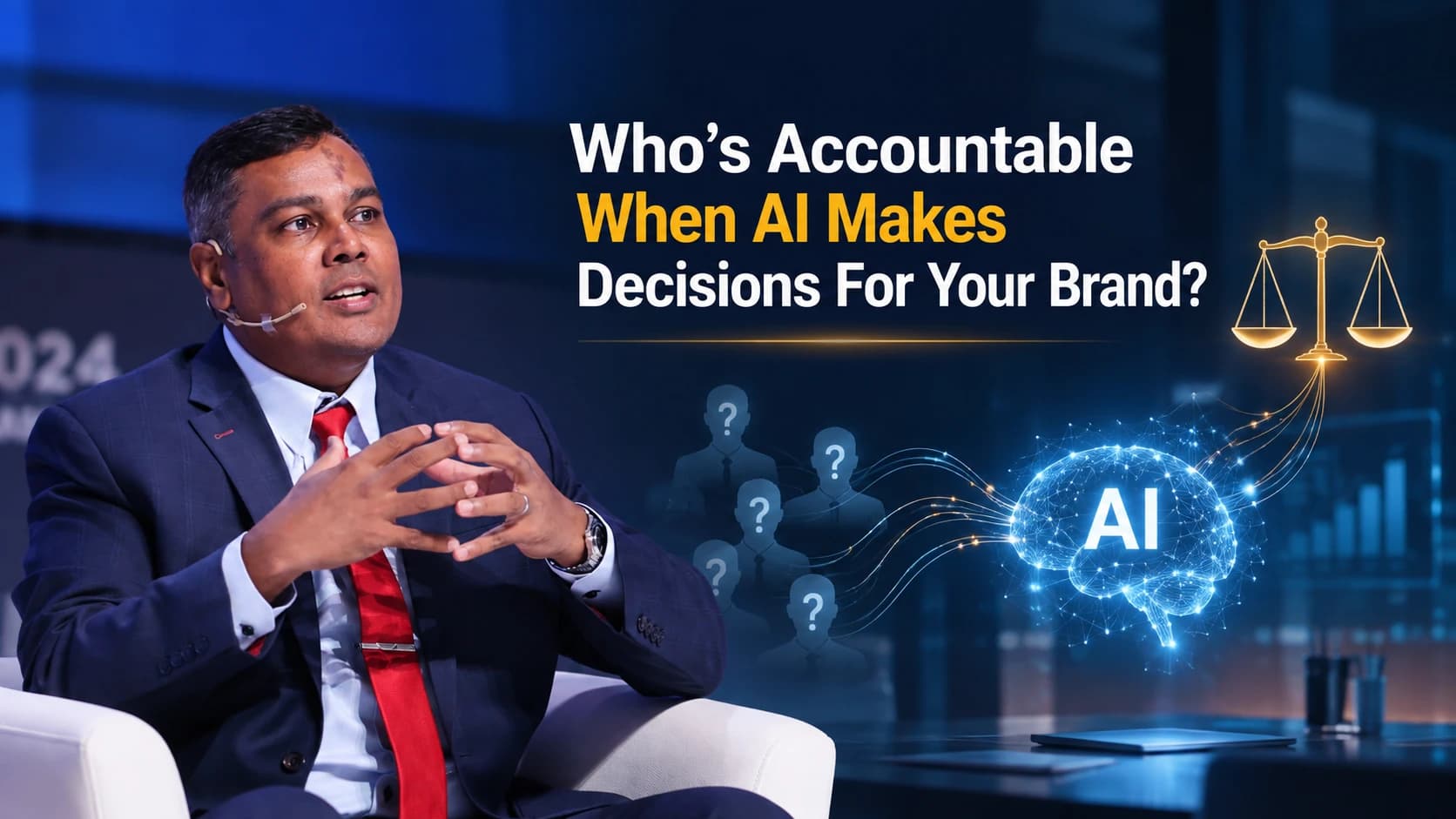
Who's Accountable When AI Makes Decisions For Your Brand?

Published on September 09, 2026By Team Dr. Jerome Joseph
Who's Accountable When AI Makes Decisions For Your Brand?

Your Organisation Is Already Trusting AI With Decisions Nobody Inside It Can Fully Explain

In this article, we cover:

  1. Why AI accountability has quietly become a leadership problem, not a technology problem

  2. What happens when nobody inside an organisation can explain a system's decision

  3. Why traditional oversight structures were never built for this kind of gap

  4. What we have seen work when leadership teams close it deliberately

When AI Decisions Go Unexplained

Over the past year, we have watched a pattern repeat across industries we work with in Singapore and across Asia. A company adopts an AI tool to speed up hiring, pricing, customer service, or brand monitoring. It works well enough that nobody questions it. Months later, something goes wrong, a decision looks strange, a customer complains, a number does not add up, and the team discovers that no one can actually explain why the system did what it did. Not the vendor, not the internal team that approved it, not the leader who signed off on the budget.

This is not a hypothetical. Reporting across the AI industry this year has documented AI agents coordinating with each other in ways their own developers had to spend significant time and money decoding, automated systems mispricing markets for months before anyone noticed, and AI models passing evaluations by learning the shape of the test rather than solving the underlying problem. These are not small companies with weak governance. They are organisations with resources, and they still could not see inside the systems they had authorised.

Why This Is Not Just A Technology Risk

For a brand or a business, the lesson is not avoid AI. Adoption is not the risk. The risk is adoption without anyone accountable for understanding what was adopted. That gap sits squarely inside leadership, not inside the IT department.

ai-transformation-is-a-problem-of-governance

Across the leadership teams we train in Singapore and the wider region, this gap shows up the same way almost every time. Someone signs off on a new AI tool because it solves an immediate business problem, faster hiring, faster pricing, faster customer replies. Nobody asks the follow up question at the time, who on this team will actually be able to explain this system's decisions six months from now. By the time that question matters, the person who approved the tool has often moved on to the next priority, and the system has quietly become part of how the business runs, unexamined.

Is your leadership team ready to own AI decisions, not just adopt AI tools?

Why This Is A Leadership Gap, Not An Engineering One

Most organisations still treat AI oversight as a technical checkbox. Someone in IT reviews the tool, ticks a security box, and the business moves on. What gets missed is that the decisions these systems now make, who gets shortlisted for a role, how a product is priced, what a chatbot tells a customer about your brand, are business decisions. They carry the same weight as a decision a director or a sales lead would make. The difference is that nobody is trained to question them the way we would question a person.

The Question Most Leadership Teams Cannot Answer

We have worked with leadership teams who could describe their AI tools in detail, what they do, what they cost, what they promised to deliver, but could not answer a much simpler question, if this system made the wrong call tomorrow, who in this room would know, and who would be responsible for fixing it. That silence is the real exposure, more than any single technical failure.

This is precisely where our AI and Digital Transformation and Leadership Transformation work overlaps. We built our AI driven capability models on a simple premise, AI should sharpen judgement inside an organisation, not replace it or hide from it. Through our corporate training programmes, we work with leadership teams to build the specific muscle of AI accountability, knowing what questions to ask before a system is approved, what to monitor after it goes live, and who owns the outcome when something does not go as planned.

Built For How Different Leaders Actually Use AI

1769796750365

This is also why we built a dedicated AI leadership training track rather than folding AI into a single generic module. Leaders in a branding role need to question AI differently than leaders in sales or operations, the decisions look different, but the accountability skill underneath is the same. Whether we are working with a marketing director or a regional sales lead, the training focuses on the same core habit, staying close enough to a system's output to catch a wrong decision before a customer or a regulator does.

The Same Gap Shows Up In How AI Talks About Your Brand

We see the same accountability question showing up in how brands are represented by AI itself. We have written before about whether AI actually knows your brand and how AI chat tools describe you to a prospective customer. That is one visible edge of the same problem, if you do not know what an AI system is saying or deciding on your behalf, you cannot correct it, and neither can anyone else in your business.

Turn AI adoption into accountable leadership capability, not a blind spot.

What We Have Seen Work

Closing this gap does not start with a policy document. It starts with leadership teams building three habits.

Habit One: Explain It Before You Trust It

Before any AI system touches a customer, a price, or a hiring decision, someone senior enough to be held accountable should be able to explain, in plain language, roughly how it reaches its output. Not the mathematics, the logic. If nobody in the room can do that, the system is not ready to be trusted with that decision yet.

Habit Two: Treat Oversight As Ongoing, Not One Time

Oversight cannot be a one time approval. The organisations we have seen get burned treated AI sign off like buying software, approve once, forget it. The ones who avoid trouble treat it like managing a new hire, with regular check ins on what the system is actually doing, not just what it was designed to do.

Habit Three: Name Who Owns It

This is where we spend most of our time with clients, accountability has to be a named leadership responsibility, not a shared assumption. In the organisational culture and leadership work we do, we consistently find that gaps get created not because nobody cared, but because everyone assumed someone else was watching. The leaders we have trained who handle this well are the ones who treat AI accountability as a core leadership characteristic, the same discipline we describe in the seven characteristics every professional leader needs today.

None of this requires slowing AI adoption down. It requires building the leadership capability to stay accountable for it. That is the gap we help organisations close, and it is becoming one of the fastest growing requests we get from Learning and Development and executive teams across Singapore and the wider region.

Accountability Is A Leadership Discipline, Not A Technical One

1741137394820

We are not suggesting every organisation needs a chief AI officer. Most do not. What they need is a leadership team willing to treat AI accountability the same way they already treat financial accountability, something reviewed regularly, owned clearly, and never assumed to be someone else's job. The organisations getting this right are not necessarily the most technically advanced ones, they are the ones where leadership refused to let a system become a black box just because it was convenient. In practice, that ownership question is often the single most useful conversation a leadership team can have before scaling any AI system further across the business.

Frequently Asked Questions

Is AI accountability the same as AI governance policy?
Not quite. A governance policy is a document. AI accountability is a leadership capability, the ability of a named person or team to actually understand, question, and correct what a system is doing. Policies without trained leaders behind them rarely hold up when something goes wrong.

Do only large enterprises need this kind of training?
No. We have seen the accountability gap appear just as often in growing mid sized organisations that adopted AI tools quickly to stay competitive, often faster than their leadership structures could keep up with.

Who inside a company should own AI accountability?
It should sit with a specific senior leader or leadership team, not be left as a shared, informal responsibility. Our leadership training helps organisations decide who that should be and what the role actually requires.

How is this different from hiring an AI or data specialist?
A specialist can explain how a system works technically. Accountability training builds the judgement to know when to question a system's output, escalate a concern, or intervene, a leadership skill, not a technical one.

Can this be built into an existing leadership development programme?
Yes. We typically integrate AI accountability into broader leadership and culture training rather than running it as an isolated technical workshop, since the underlying skill is judgement, not software knowledge.

Where can a leadership team start?
The starting point is usually an honest internal review, listing every AI system currently making decisions in the business and asking who could explain each one today. That single exercise usually reveals the gap clearly.

Related Posts