Logo
Sales Transformation

The Beliefs Costing You Deals: Five Sentences Your Sales Team Says to Themselves

Published on August 11, 2026By Team Dr. Jerome Joseph
The Beliefs Costing You Deals: Five Sentences Your Sales Team Says to Themselves

The Man Who Would Not Say His Job

At a networking event some years ago, Dr Jerome Joseph was facilitating a group activity where each person introduced themselves and described what they did.

The first said he was a lawyer. The second said he was a CEO. The third asked to pass.

Afterwards, Jerome asked him why. The man gave two reasons. The first was that hearing lawyer and CEO had made him embarrassed, because he was only an insurance agent. The second was that whenever he did say it, people stepped away, because they assumed he wanted to sell them something.

Two sentences. Both of them beliefs rather than facts. And between them, they had removed him from every conversation in the room.

We open with this because it is the clearest illustration we know of something that costs organisations far more than any skill gap does. This man was presumably competent at his job. His problem was not capability. It was that he had accepted two propositions about himself and about his profession, and those propositions were making decisions on his behalf before he opened his mouth.

Sales teams do this constantly. The beliefs are usually more specific and better disguised, but the mechanism is identical, and the cost lands directly on revenue.

Why This Gets Missed

Sales training targets behaviour. Discovery questions, objection handling, closing technique, pipeline discipline. All useful, all teachable.

But behaviour is downstream of belief, and a great deal of sales loss happens before any behaviour occurs at all. It happens in the decision not to make the call. The email that gets drafted and not sent. The meeting that gets rescheduled by the salesperson rather than the client. The follow up that quietly stops after the second attempt.

None of that appears in a CRM. There is no field for the call that was never made. Which means the most expensive category of sales loss in most organisations is also the least visible, and no amount of technique training touches it.

Below are the five sentences we hear most often. Each is followed by where it comes from, what it actually costs, and what changes it, because none of these respond to being told they are irrational.

WATCH VIDEO NOW

The most expensive sales losses are the calls that never got made.

One: "I'm bothering them"

The most common belief in professional services and B2B sales, and the most polite sounding.

Where it comes from. Usually from a genuine early experience of being brushed off, combined with a personal dislike of being sold to. The salesperson generalises from their own irritation at cold calls and concludes that all outreach is an imposition.

What it costs. This one shows up as follow up decay. Most B2B deals require several touches, and the majority of salespeople stop well before that number, not because the prospect said no but because nobody said anything and the silence felt like a signal. Every deal lost in that gap is a deal that was not lost on merit.

What changes it. Not encouragement, which reads as pressure to be pushier. What changes it is reframing the follow up as information rather than persuasion. A message that gives the prospect something they can use, whether or not they buy, is not an imposition, and the salesperson knows this because they would not mind receiving it. The behaviour follows once the belief is no longer accurate.

Two: "They'll say no anyway"

Where it comes from. A run of losses, often in a period where market conditions or product fit were genuinely poor. The salesperson correctly observed a pattern and then kept applying it after the conditions changed.

What it costs. Selective effort. This belief does not stop someone working. It stops them working on the difficult opportunities, which are frequently the large ones. The pipeline fills with easy, small, low margin deals, and the average deal size quietly declines over two or three quarters while activity metrics look healthy.

What changes it. Evidence, specifically their own. Have the salesperson list the last ten opportunities they deprioritised and what happened to each. Usually two or three went to a competitor on terms that were entirely winnable. Nothing anyone says is as persuasive as that list, because they compiled it themselves.

Three: "I can't defend this price"

Where it comes from. Almost always a real gap in the salesperson's understanding of what the organisation actually does differently. If they cannot articulate the difference, the price genuinely does look arbitrary to them, and they will transmit that doubt.

What it costs. The most directly measurable of the five. Discounting is where this belief lands, and it compounds, because a discount given once becomes a precedent that shapes every subsequent negotiation with that account and eventually with the market. We have written about the wider pattern in our work on developing a winning sales mindset.

What changes it. This is not a mindset intervention. It is a knowledge one. The salesperson needs to be able to name, specifically, what the organisation does that the alternative does not, and why it is worth the difference. If leadership cannot supply that answer clearly, the belief is not a limiting belief at all. It is an accurate observation, and the problem sits upstream in positioning rather than in the sales team.

Four: "I'm only the salesperson"

The direct descendant of the insurance agent's belief, and the one that most affects senior conversations.

Where it comes from. Status anxiety in rooms where other people hold titles that sound weightier. It intensifies when selling into senior buyers, which is precisely where it does the most damage.

What it costs. Deference. A salesperson holding this belief will not challenge a buyer's stated requirement even when they can see it is the wrong requirement. They will take the brief, quote the brief, and lose to a competitor who told the buyer something more useful. Senior buyers consistently report valuing the supplier who reframed the problem, and this belief makes that impossible.

What changes it. Establishing, concretely, what the salesperson knows that the buyer does not. Someone who has seen this problem in thirty organisations holds knowledge the buyer has no access to. That is not a matter of confidence or self talk. It is a fact about the distribution of information in the room, and salespeople who have it pointed out to them tend to behave differently within days. The related shift in how conversations are closed is something we cover in our piece on closing with confidence through the assumptive close.

Five: "Selling isn't really who I am"

The quietest of the five and the hardest to detect, because the people holding it are often good at the job.

Where it comes from. A view of selling as something done to people rather than for them, usually absorbed long before the person entered the profession. It is especially common in technical specialists who moved into commercial roles.

What it costs. It produces salespeople who wait. They respond well to inbound, they handle relationships capably, and they do not originate. The pipeline depends entirely on marketing, and the organisation concludes it has a lead generation problem when it has a belief problem.

What changes it. Separating the act from the caricature. Most people holding this belief are objecting to a specific style of selling, not to selling itself, and they usually recognise the difference immediately when it is named. What they will not do is adopt a persona, and asking them to is what confirms the belief rather than dissolving it.

Working Out What This Is Costing You

Leadership teams engage with this properly once there is a number attached, and the number is usually obtainable.
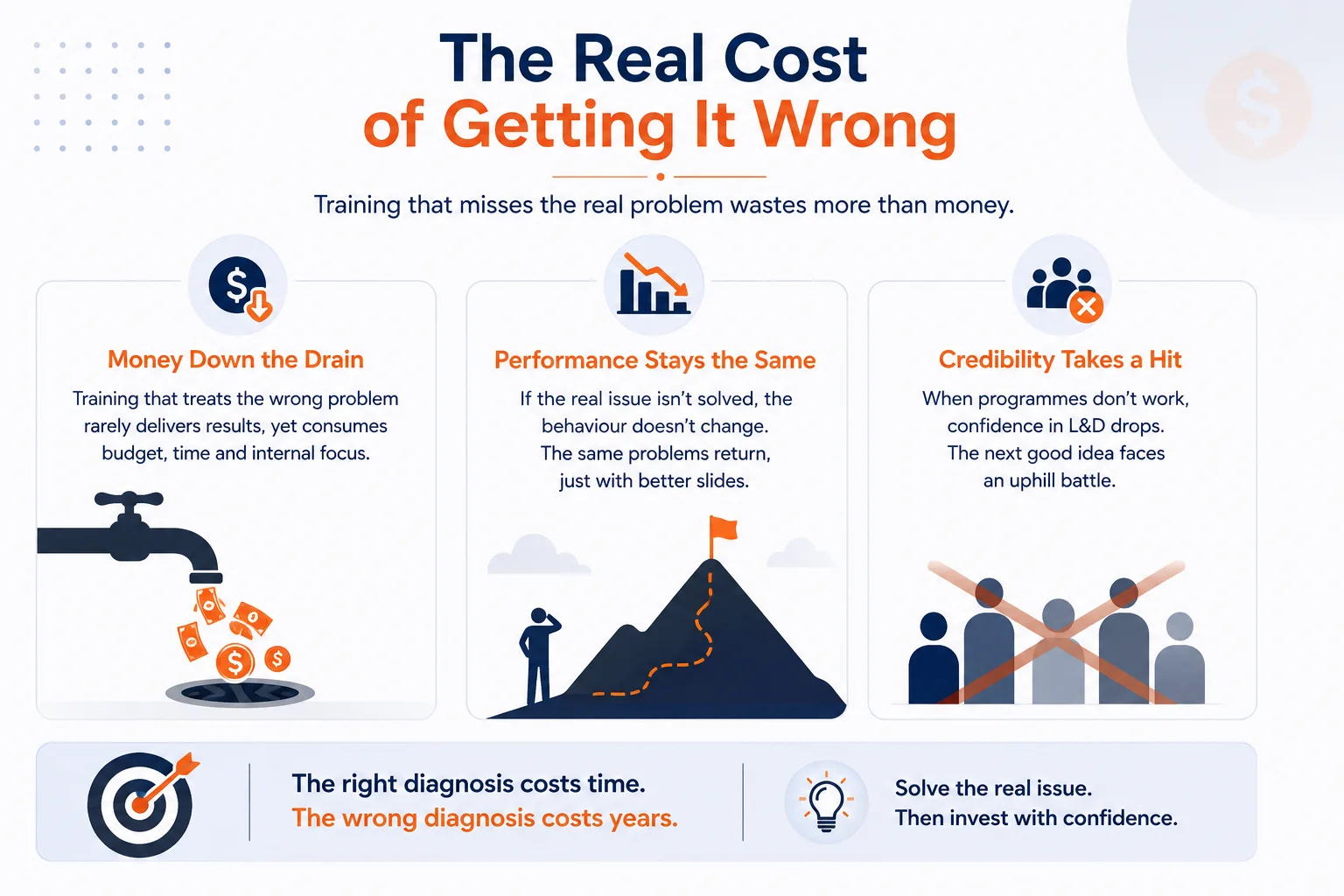
The Real Cost of Getting It Wrong

Take one belief, the follow up one, since it is the easiest to measure. Establish the average number of touches on your closed won deals. Then establish the average on your closed lost deals where the prospect never actually declined and simply went quiet.

If the second number is meaningfully lower than the first, you have found the gap. Multiply the difference by your average deal value and a conservative estimate of how many of those would have converted with the additional touches.

The figure is rough and it is not the point. The point is that it exists at all, because until this loss has a number, it competes for attention against problems that do, and it loses every time.

The Manager Layer Decides This

None of these beliefs shift because someone attended a session about them.

They shift because a manager notices the behaviour and names the belief underneath it. Not the behaviour, the belief. "You stopped following up on that one" is a performance conversation and produces defensiveness. "What made you think they weren't interested?" is a different conversation entirely, and it goes somewhere useful.

That means the manager has to know what to listen for, which almost none are trained to do. Sales management training focuses overwhelmingly on pipeline review, forecasting and activity metrics. Very little of it addresses the coaching conversation where these beliefs actually surface, and that omission is why so much sales training produces a short lift and then reverts.

This is a design question rather than a delivery question, and it is why our corporate training in Singapore engagements treat manager preparation as part of the programme rather than as something optional that happens afterwards if there is budget left.

Two Beliefs, Two Choices

The video at the top of this piece ends with a distinction worth keeping.
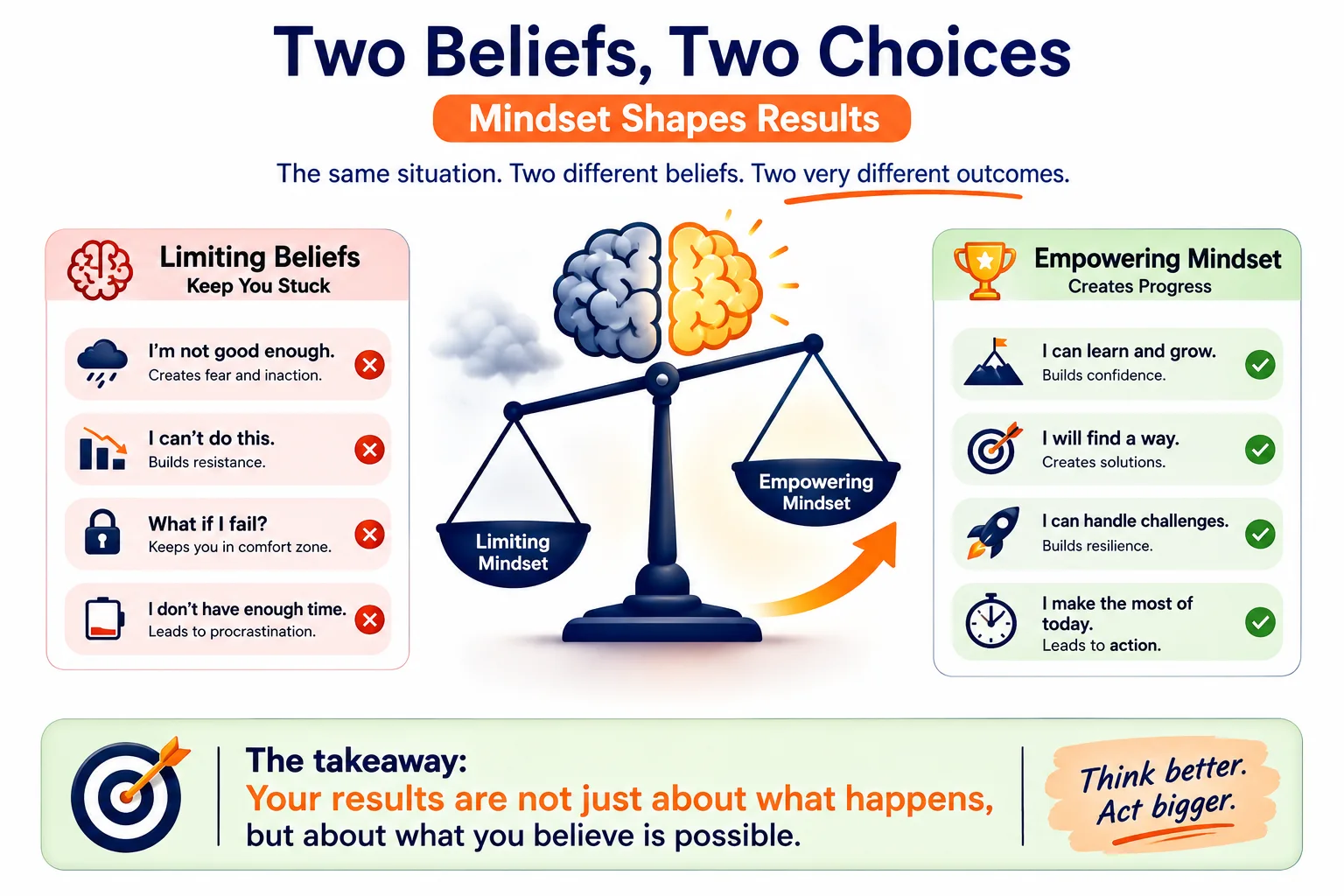
Two Choices Infographic

Limiting beliefs sound like: I'm not good enough. I can't do this. I'm going to fail.

Empowering beliefs sound like: I can do this. I have what it takes. I may fall, and I will get up.

That framing is deliberately simple, and simplicity is the point. Sales teams do not need a psychological model. They need to notice, in the moment before they decide not to make the call, that a sentence just ran through their head and that the sentence was a choice rather than a fact.

The insurance agent at that networking event was not lacking skill. He was carrying two sentences that removed him from every conversation in the room before he had said anything at all.

Most sales teams are carrying something similar. The difference between the ones that find it and the ones that do not is usually just whether anybody thought to look.

Frequently Asked Questions

What are limiting beliefs in sales?

They are assumptions a salesperson holds about themselves, their role or their prospects that restrict behaviour before any behaviour occurs. Common examples include believing that follow up is an imposition, that difficult opportunities will not convert, or that they cannot defend the price. They differ from skill gaps because the person is capable of the action and does not take it.

How do limiting beliefs affect sales performance?

Mostly through actions that never happen, which makes them hard to detect. Follow up stops early, difficult opportunities get deprioritised, prices get discounted without a real challenge, and outbound activity quietly reduces. None of these appear in a CRM, because there is no record of a call that was not made.

Can sales training fix limiting beliefs?

Only partly, and only if the training is designed for it. Technique training targets behaviour, which sits downstream of belief. Programmes that address beliefs directly, and that equip sales managers to recognise them in coaching conversations, produce more durable change than technique training alone.

What is the difference between a limiting belief and a legitimate concern?

A legitimate concern is supported by current evidence. A limiting belief was accurate at some point and has outlasted the conditions that made it true. The useful test is to ask what evidence would change the view. A concern usually has an answer to that question. A belief usually does not, and if a salesperson cannot defend the price because leadership has never articulated the difference, that is a legitimate concern and the problem sits upstream.

How can sales managers identify limiting beliefs in their team?

By asking about reasoning rather than outcomes. "What made you think they were not interested" surfaces the underlying assumption, while "you stopped following up" produces defensiveness and a justification. The pattern usually becomes visible across three or four such conversations.

How long does it take to shift a limiting belief?

Faster than most people expect when the intervention is evidence based rather than motivational. A salesperson who compiles their own list of deprioritised opportunities and sees what happened to them often changes behaviour within days. Beliefs tied to identity, such as discomfort with selling itself, take longer and generally require the belief to be named accurately rather than argued against.


Related Posts