How They Work Together
In practice, the choice is rarely permanent. Most organisations need both, and the sequence matters more than the split.
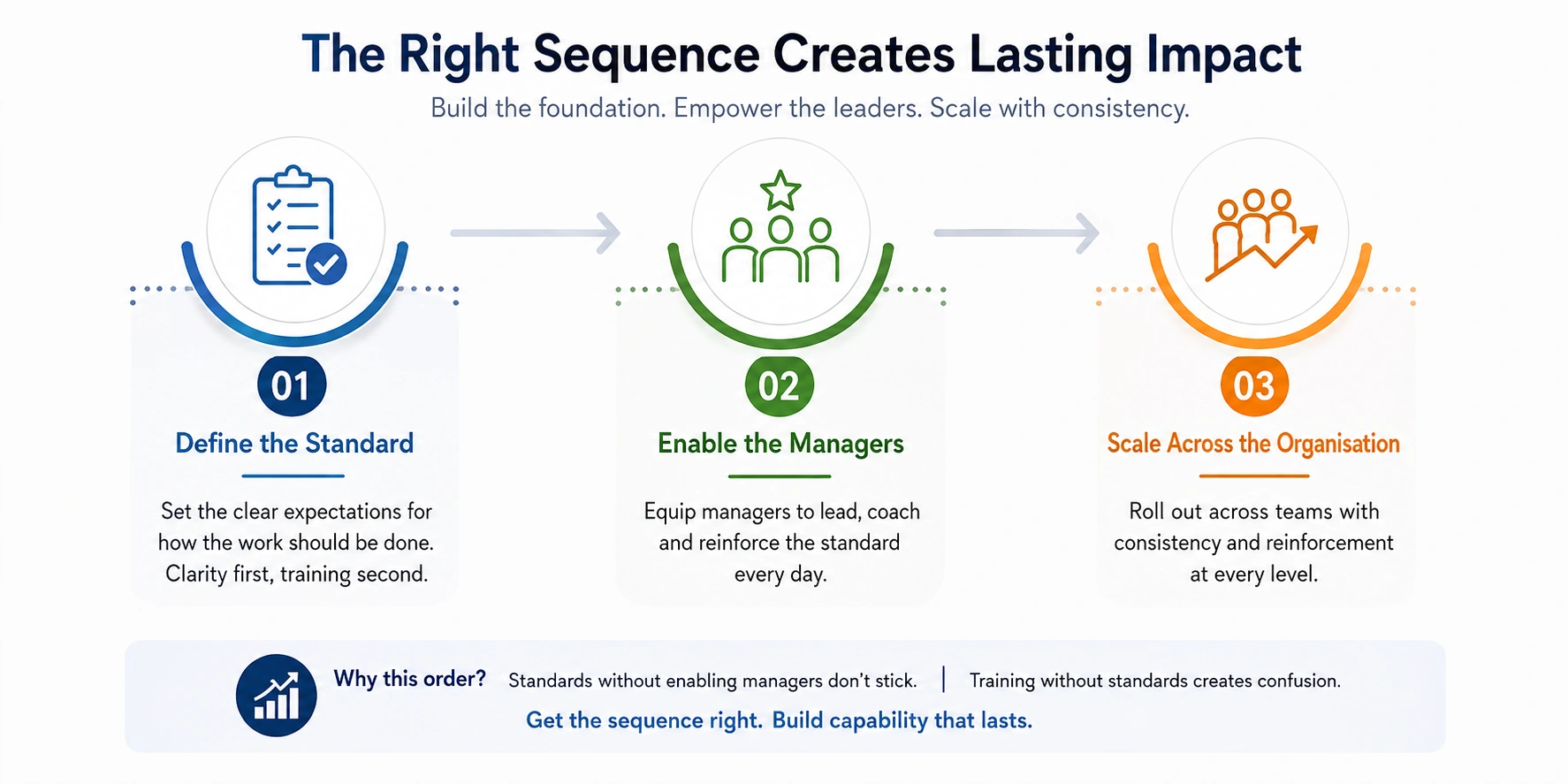
The order that works in our experience is this.
Establish the standard first. Before anyone is trained on how to lead others toward a standard, the standard has to exist in a form that can be applied. This is usually broader corporate training territory, defining what good looks like in the specific activities that matter.
Equip the manager layer second. Managers are the transmission mechanism for everything else. A capability programme that reaches the frontline without preparing supervisors will fade within a quarter, because the daily signal from a manager reaches an employee far more often than any programme does.
Scale to the wider organisation third. Once the standard exists and managers can hold it, broader delivery works, because there is something consistent to deliver.
Most organisations run this in reverse. They train the frontline first, then wonder why it did not stick.
The Singapore Context
Two factors make this decision different in Singapore than elsewhere.
Funding changes the arithmetic. Government supported training funding significantly alters the cost comparison between programme types, and the schemes have specific eligibility criteria that favour certain formats and accredited content. This can make a broader accredited programme substantially cheaper per head than an equivalent bespoke leadership engagement. We have set out how this works in our guide to WSQ training programmes and why they matter for Singapore workplaces. It is worth checking eligibility before finalising any budget, because it frequently changes the decision.
Regional teams complicate delivery. Many Singapore headquartered organisations run teams across the region. A leadership programme designed for a Singapore management culture does not transfer unchanged to Jakarta, Bangkok or Ho Chi Minh City. The judgement calls differ, the norms around directness differ, and a programme that ignores this produces managers who have learned an approach that does not work with their actual teams. Our leadership training work in Singapore is built with that regional variation in mind rather than assuming a single model applies everywhere.
A Short Decision Guide
If you are deciding right now, work through these in order.
First, write down the specific business outcome you want to change. Not "better leadership" but something observable, such as fewer escalations, faster deal cycles, lower turnover in a specific team, or more consistent service scores.
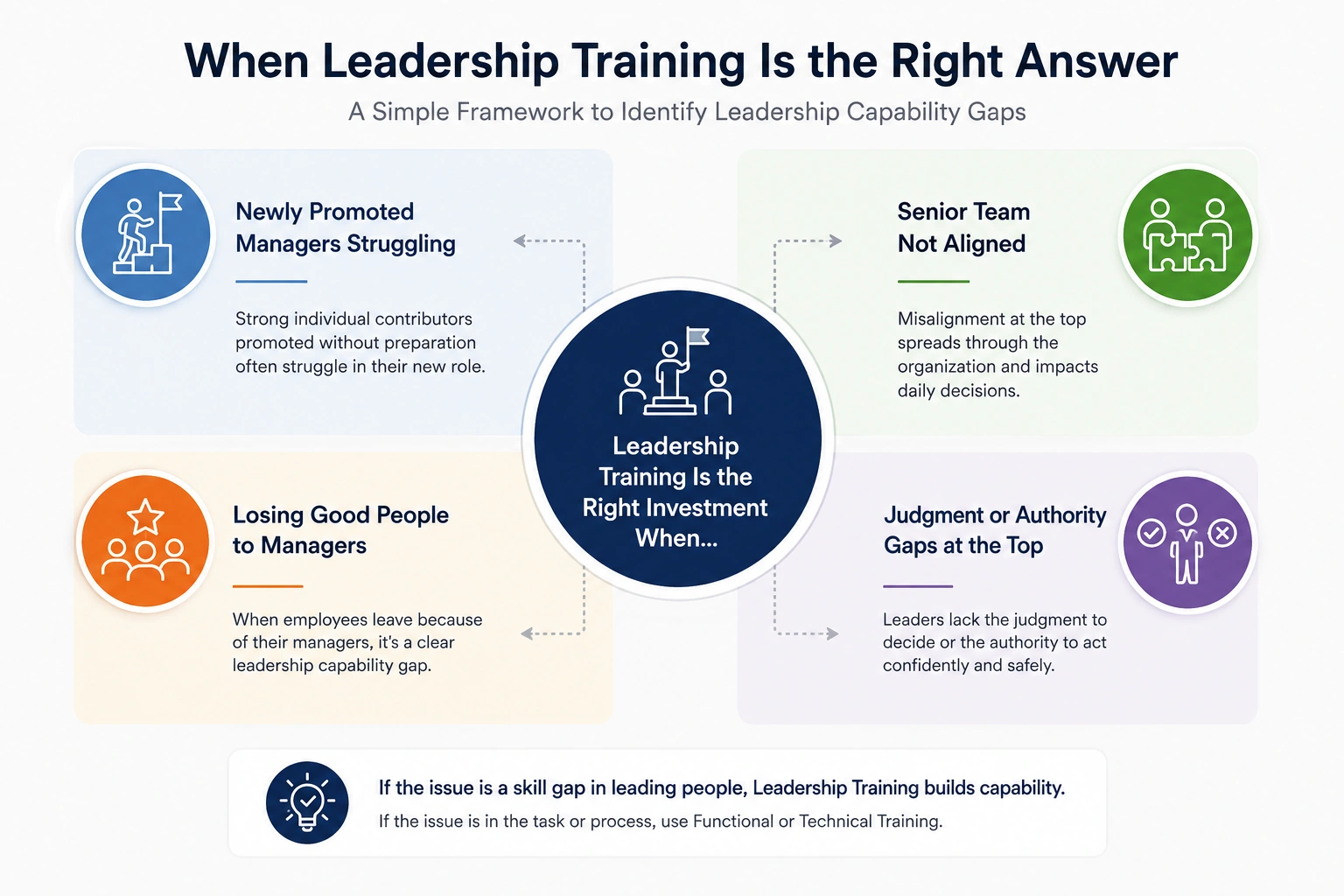
Second, identify whether the people involved lack a skill or lack judgement and authority. Skill points to broader training. Judgement points to leadership training. Authority points to neither, and to a structural fix instead.
Third, check whether the measurement system currently rewards the behaviour you want. If it does not, fix that before spending anything on training, because the incentive will override the training within weeks.
Fourth, check funding eligibility, because it may change what is affordable.
Fifth, decide how you will know in ninety days whether it worked, and write that down before the programme starts. A measure chosen afterwards will always be chosen to flatter the result.
If that process points toward broader capability building across functions, our corporate training programmes in Singapore are structured around exactly this sequence, starting with the outcome rather than the curriculum.
Frequently Asked Questions
What is the difference between leadership training and corporate training?
Corporate training is the broad category covering capability development across an organisation, including functional skills, service, sales, brand and compliance. Leadership training is a specific subset focused on developing judgement and behaviour in people who direct others. Every leadership programme is corporate training, but most corporate training is not leadership training. They differ in audience size, duration, cost per head and how results are measured.
Which should a Singapore company invest in first?
It depends on whether the gap is in skill or in judgement. If performance varies widely among people doing the same job, that is a skill gap and broader training addresses it. If competent people are escalating decisions they could make themselves, that is a judgement or authority gap and leadership training or a structural fix is more appropriate. Reviewing the last ten escalated decisions usually makes the answer clear.
Is leadership training more expensive than general corporate training?
Per participant, yes, usually significantly. Leadership programmes involve smaller groups, longer durations and often individual coaching. However, the comparison should be made against the outcome rather than the headcount. A leadership intervention affecting fourteen managers who each lead twenty people reaches a much larger population indirectly than the participant count suggests.
Can government funding be used for both types of training in Singapore?
Funding schemes have specific eligibility criteria that generally favour accredited programmes and defined competency frameworks. This means some programme types qualify more readily than others, and eligibility can meaningfully change the cost comparison. Check eligibility before finalising a budget rather than after, since it often affects which option is realistic.
How long before leadership training shows results?
Behavioural change in participants is usually visible within one to two months. Effects on team performance typically appear across two to four quarters, because the change has to travel through the participant to their team before it shows in outcomes. Broader functional training generally shows measurable effect faster, within weeks to a quarter, because it targets a specific activity directly.
What if we need both but can only fund one this year?
Establish the standard first through broader capability work, then equip managers the following cycle. A leadership programme delivered before there is a clear standard to lead toward tends to produce energised managers with nothing specific to apply, and the effect dissipates. The reverse sequence, standard first and leadership second, holds better.