Logo
Sales Transformation

Sales Team Performance Metrics: What Actually Matters in 2026

Sales Team Performance Metrics: What Actually Matters in 2026

Tracking more metrics is not the same as understanding performance. Most sales teams have the first. Very few have the second.

Ebsta's 2025 benchmark report found that 78 per cent of sellers missed quota, despite sales teams collecting more data than at any point in history. The problem is rarely a lack of metrics. It is a lack of clarity about which ones actually drive the outcome that matters.

Here is what this post covers:

  1. Why more dashboards have not produced better results.

  2. The difference between a metric and a KPI, and why it matters.

  3. The seven sales team performance metrics worth your attention.

  4. How leading and lagging indicators work together.

  5. Building this into what makes a high performance sales team.

  6. A simple weekly measurement cadence that works.

WATCH VIDEO NOW

If your sales dashboard has 30 metrics and no clear answer, this will help.

Ebsta's 2025 GTM Benchmarks report found that win rates fell 18 per cent year over year, and sales cycles stretched 38 per cent longer than they were in 2021. None of this happened because sales teams stopped measuring. It happened because most teams measure effort, not the signals that predict revenue.

Photograph of printed statistic cards showing 78 percent of sellers missed quota in 2025 and 18 percent decline in win rate year over year

1. Why More Dashboards Have Not Produced Better Results

The average sales organisation now tracks dozens of metrics across multiple platforms. Most of those numbers get reviewed once the quarter is already lost, which makes them a record of what happened rather than a tool for changing it.

  • Reviewing metrics after the quarter ends explains misses, it does not prevent them

  • A high volume of tracked data does not equal a high volume of useful decisions

  • Leadership teams often confuse activity, having more numbers, with insight, knowing which numbers to act on

  • The goal of measurement is not visibility for its own sake, it is a clear trigger for a specific decision

2. The Difference Between a Metric and a KPI, and Why It Matters

Every KPI is a metric. Very few metrics are KPIs. Confusing the two is the single biggest reason sales dashboards become noise rather than a management tool.

  • A metric is any quantifiable data point related to sales activity, calls made, emails sent, meetings booked

  • A KPI is a metric with three things attached: a clear owner, a defined target, and a decision that changes when it moves

  • Win rate, quota attainment, and pipeline coverage are KPIs because each one triggers a specific response when it shifts

  • Number of calls made is a metric, useful for coaching, but not a KPI on its own

  • Sales leaders who manage too many metrics as if they were all KPIs create confusion rather than focus

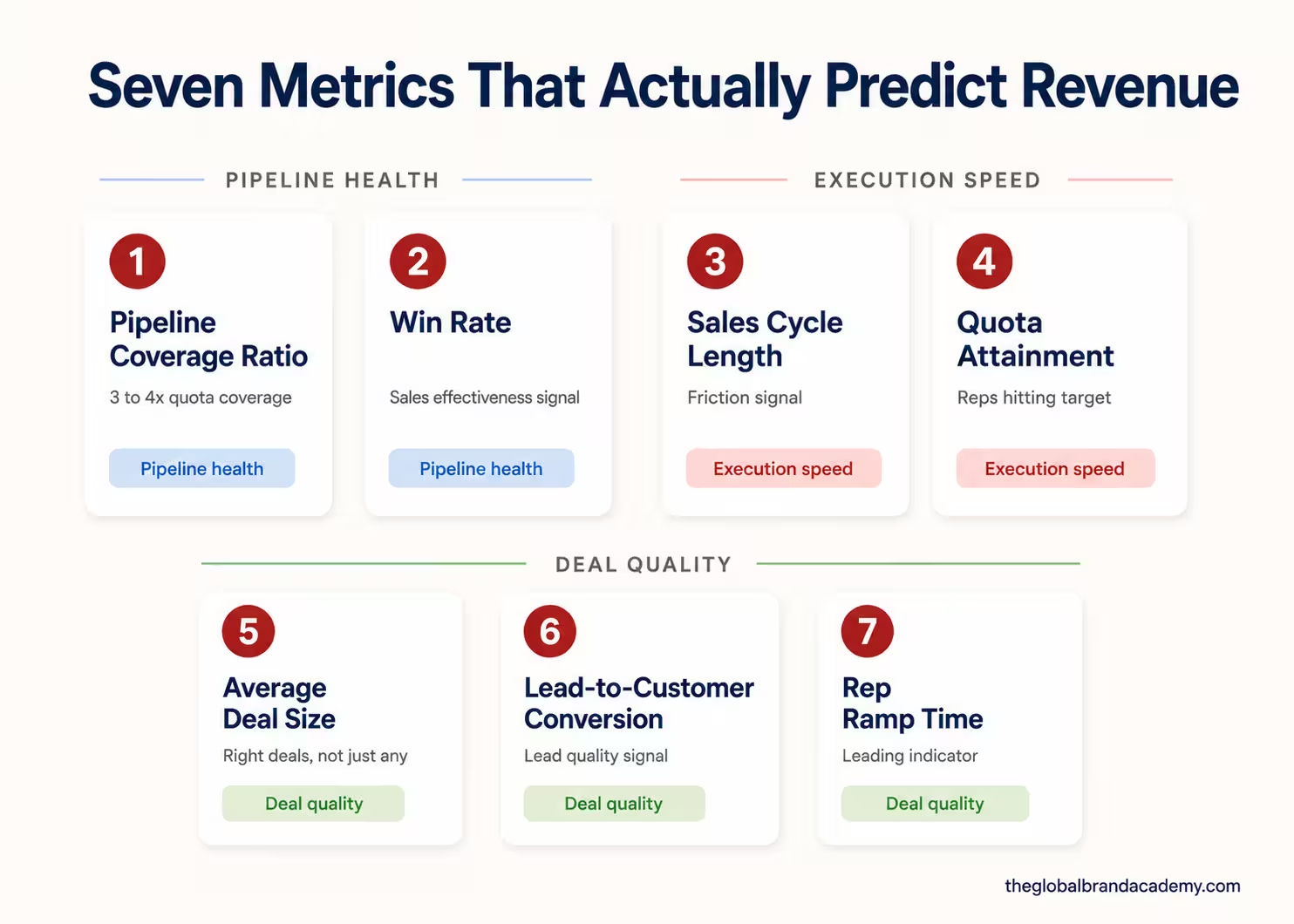
3. The Seven Sales Team Performance Metrics Worth Your Attention

Seven sales team performance metrics grouped by pipeline health execution speed and deal quality
  • Pipeline coverage ratio. Best-in-class teams maintain three to four times their quota in active pipeline value

  • Win rate. The percentage of opportunities closed, the clearest single signal of sales effectiveness

  • Sales cycle length. How long deals take from open to close, a rising number signals friction worth investigating

  • Quota attainment. The percentage of reps hitting target, low attainment across the board signals a target or process problem, not just an effort problem

  • Average deal size. Tracks whether the team is winning the right deals, not just any deals

  • Lead-to-customer conversion rate. Reveals whether the issue sits in lead quality or in sales execution

  • Rep ramp time. How quickly new hires reach full productivity, a leading indicator for future quota attainment

4. How Leading and Lagging Indicators Work Together

Leading indicators predict performance while there is still time to act. Lagging indicators confirm results after the fact. Strong sales leadership uses both, in sequence, rather than relying on one alone.

  • If quota attainment is under pressure, the leading metrics to check are pipeline coverage and rep ramp progress

  • If win rate is declining, look upstream at qualification quality and message consistency before assuming a closing problem

  • A lagging metric tells you whether last quarter's fix actually worked

  • A leading metric tells you what to fix before the quarter is lost, not after

5. Building This Into What Makes a High Performance Sales Team

Metrics on their own do not build a high performance sales team. The teams that consistently hit revenue targets are deliberate about exactly which metrics they manage, and they connect that discipline to the broader habits, culture, and structure already outlined in what makes a high performance sales team in 2026.

  • Measurement discipline is one of the clearest, most consistent traits separating a high performance sales team from an average one

  • The qualities that define a high performance sales team, clarity, accountability, coaching rhythm, only become visible at scale once the right metrics are in place to see them

  • A team can have excellent culture and still underperform if leadership cannot see where execution is actually breaking down

  • Pairing the right metrics with the right team habits is what turns good intentions into a measurable, repeatable result

6. A Simple Weekly Measurement Cadence That Works

Measurement cadence infographic showing daily activity metrics weekly connect rate and reply rate monthly coverage ratio and win rate by Global Brand Academy Singapore
  • Daily, reviewed by reps. Activity metrics, calls made, emails sent, meetings booked, useful for coaching, not for strategic decisions

  • Weekly, reviewed by managers. Conversion metrics, connect rate, reply rate, meeting-to-opportunity rate

  • Monthly, reviewed by leadership. Pipeline metrics, coverage ratio, win rate, quota attainment, the numbers that inform forecasting and resourcing decisions

Fewer metrics, clearer decisions, stronger results.

About the Author

Dr Jerome Joseph is a globally recognised brand thought leader, keynote speaker, and strategic advisor with 30 years of experience across 40 countries and more than 1,000 brands. He is the author of 12 books on brand strategy, personal branding, and leadership, an inductee of the Asia Speaker Hall of Fame, a Global Speaking Fellow, and a Certified Speaking Professional. Dr Jerome Joseph has worked with sales leadership teams across Singapore and Asia, helping organisations build the measurement discipline and team habits that define a genuinely high performance sales team.

Final Thoughts

The sales teams missing quota in 2026 are rarely short on data. They are short on clarity about which data actually matters.

  • 78 per cent of sellers missed quota despite unprecedented access to sales data

  • The fix is rarely more metrics, it is fewer, better metrics with a clear owner and a clear trigger

  • Pipeline coverage, win rate, and rep ramp time consistently predict revenue better than activity volume alone

  • Measurement discipline is one of the defining traits of what separates a high performance sales team from an average one

What is the difference between a sales metric and a sales KPI?
A sales metric is any quantifiable data point related to sales activity, such as calls made or emails sent. A sales KPI is a specific subset of metrics that has a clear owner, a defined target, and triggers a decision when it moves. All KPIs are metrics, but not all metrics are KPIs worth managing closely.

Which sales team performance metrics matter most in 2026?
The seven metrics with the strongest link to revenue outcomes are pipeline coverage ratio, win rate, sales cycle length, quota attainment, average deal size, lead-to-customer conversion rate, and rep ramp time. Most other tracked metrics support coaching but do not predict revenue on their own.

Why did sales teams miss quota despite tracking more data than ever?
Ebsta's 2025 GTM Benchmarks report found 78 per cent of sellers missed quota even as data collection increased. The gap is usually a measurement discipline problem, not a data availability problem.

What is a good pipeline coverage ratio for a B2B sales team?
Best-in-class B2B teams maintain a pipeline coverage ratio of three to four times their quota. Lower coverage typically signals a lead generation or qualification problem.

How often should sales metrics be reviewed?
Activity metrics should be reviewed daily by reps for coaching purposes. Conversion metrics work best reviewed weekly by managers. Pipeline and revenue metrics should be reviewed monthly by leadership for strategic decisions.

How do sales metrics connect to building a high performance sales team?
Measurement discipline is one of the clearest traits separating high performance sales teams from average ones. The right metrics make visible whether the habits and culture that define a high performance sales team are actually translating into results.


Related Posts