About the Author
Dr Jerome Joseph is a globally recognised brand thought leader, keynote speaker, and strategic advisor with 30 years of experience across 40 countries and more than 1,000 brands. He is the author of 12 books on brand strategy, personal branding, and leadership, an inductee of the Asia Speaker Hall of Fame, a Global Speaking Fellow, and a Certified Speaking Professional. Dr Jerome Joseph has worked with leadership teams across Singapore and Asia on building motivation, culture, and leadership resilience strategies that address the root causes of disengagement rather than its surface symptoms.
Final Thoughts
Employee motivation strategies will keep underperforming as long as they treat motivation as something delivered to employees rather than something that begins with the condition of the leader delivering it.
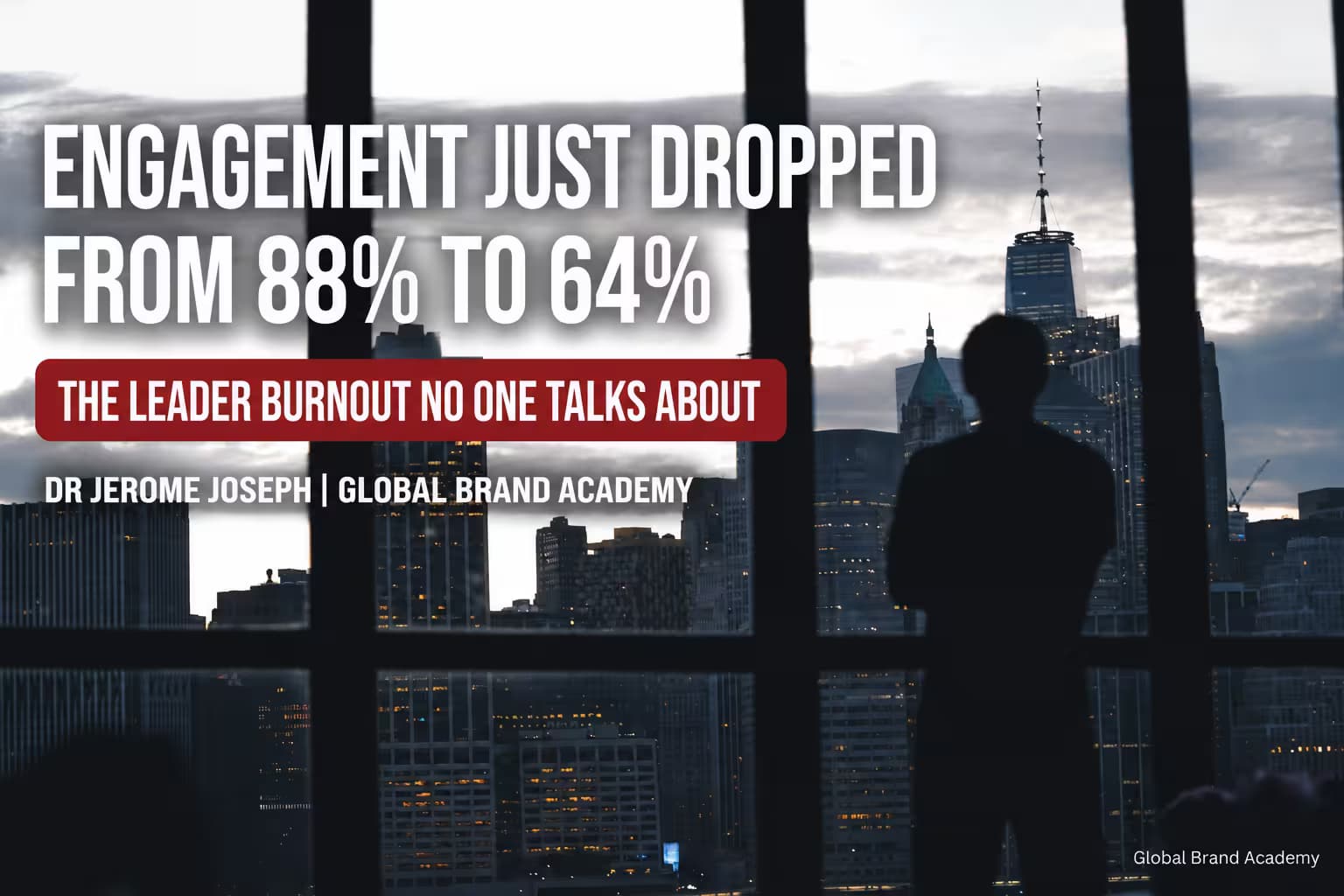
A 24 point engagement drop in one year is a signal that the standard playbook is no longer working
Leader burnout is quietly shaping team motivation in ways most organisations are not measuring
AI-related anxiety is adding a new, often invisible layer to disengagement that traditional motivation tools were not built to address
The most effective place to start rebuilding motivation is not a new employee programme. It is an honest look at how the leader is doing
Why do most employee motivation strategies fail?
Most motivation strategies assume the leader delivering recognition, feedback, and support is operating at full capacity. When leaders are burnt out, even well-designed motivation programmes land weakly because employees absorb the emotional state of their manager more than the content of any initiative. Addressing leader wellbeing is a prerequisite for effective motivation strategy, not a separate issue.
What is leader burnout and why does it matter for employee motivation?
Leader burnout refers to exhaustion and depletion experienced by managers and executives, often masked because leaders are expected to project stability regardless of how they feel. It matters because a burnt-out leader tends to show less patience, shorter engagement, and reduced presence, all of which directly shape how motivated their team feels day to day.
How is AI affecting employee motivation in 2026?
Employees who feel unsafe asking questions about new AI tools report higher stress and lower engagement. Uncertainty about long-term role relevance in an AI-enabled workplace is creating a layer of quiet anxiety that traditional motivation strategies were not designed to address. Psychological safety around AI adoption is now a performance necessity, not a cultural extra.
What actually motivates employees beyond standard perks and recognition programmes?
Specific and timely feedback, genuine trust that a leader sees their effort and workload, autonomy over how work gets done, and psychological safety to raise concerns without fear all motivate more consistently than financial incentives or generic recognition events alone.
How can leaders address their own burnout while still leading their teams?
Leaders can start by honestly assessing their own energy and stress levels before launching any team-facing initiative, treating their own restoration as a prerequisite rather than a luxury, and building genuine psychological safety so concerns, including their own, can be raised openly within the organisation.
What is the leader-first approach to employee motivation?
The leader-first approach reverses the usual sequence of motivation strategy. Instead of designing programmes for employees first, it starts by assessing and addressing the leader's own capacity, since teams consistently mirror how their leader handles pressure and uncertainty far more than they respond to formal motivation initiatives.